Television broadcast and surface communications
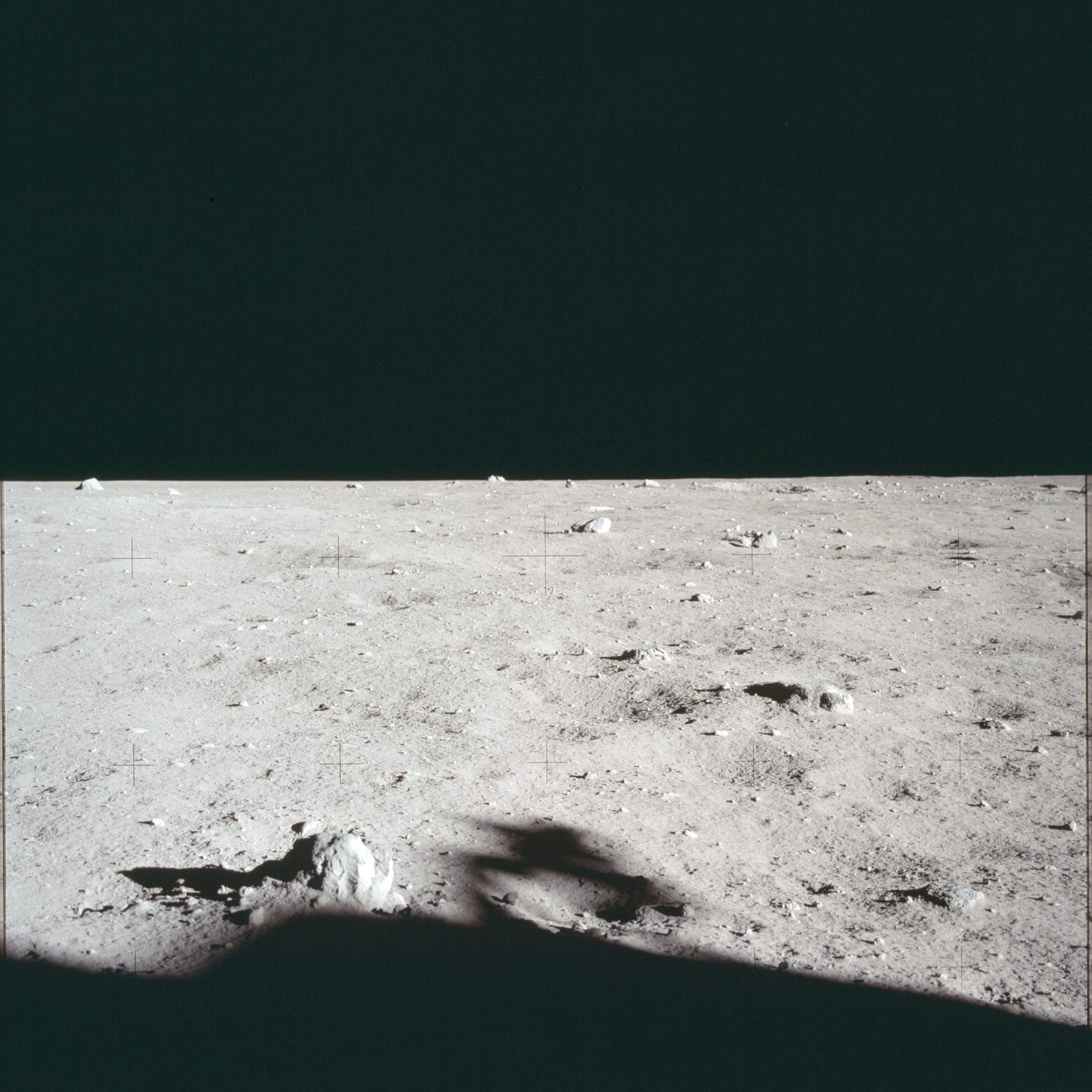
How the first moonwalk was seen and heard on Earth — the live television and the radio link that carried it. This is the hardware-and-signal counterpart to the two voice-transcript records (the technical GOSS NET 1 loop and the public PAO commentary): where those are what was said, this is how it reached the ground.
The surface TV
Section titled “The surface TV”The surface picture came from a black-and-white slow-scan TV camera stowed in the Lunar Module’s MESA (Modular Equipment Stowage Assembly). Armstrong released the MESA on the way down the ladder, and the transcript catches the first live image from another world: Houston — “We’re getting a picture on the TV… There’s a great deal of contrast in it, and currently it’s upside down on our monitor, but we can make out a fair amount of detail” — then, seconds later, “we can see you coming down the ladder now.” The image was righted on the ground, and the camera was later moved out on its cable to a tripod for a wider field. Mission Control actively managed the camera’s TV circuit breaker and read up f-stop and focus advice during the EVA. (Distinct from this surface camera, Columbia carried a color TV camera used for the translunar-coast broadcasts.)
The link: unified S-band through the MSFN
Section titled “The link: unified S-band through the MSFN”Voice, telemetry, ranging, and television were multiplexed onto a single unified S-band carrier. From the surface the signal went up through Eagle’s steerable high-gain antenna (with OMNI antennas as backup) and was received on Earth by the big dishes of the Manned Space Flight Network (MSFN) and Deep Space Network — the Goldstone 210-ft (California), Honeysuckle Creek (Australia), and the Parkes radio telescope, with Madrid in the tracking chain. The transcript is threaded with the consequences of orbital geometry: stations handing the spacecraft off at AOS/LOS (acquisition / loss of signal), the crew slewing the high-gain to REACQ, and quality calls like Goldstone reporting “a little snowy, but a good TV picture.” The steerable antenna’s one bad stretch — repeated loss of lock on revolution 14, before the descent — turned out to be a paperwork failure, not a hardware one: the Operational Data Book’s antenna-coverage diagrams omitted the late-added plume deflectors, so the chosen pointing angles sat in vehicle blockage, compounded by lunar-surface multipath (Mission Report §16.2.4, via the anomaly register). The same network’s stations and call-outs are described in GOSS NET 1; the consolidated system performance is the subject of the Mission Report’s §6 (Communications) and §13 (Mission Support).
This live coverage — watched by an estimated several hundred million people — is the mission’s most-seen artifact, and the reason the ceremonial moments (the flag, the plaque reading, the call from the President) played out in front of a global audience in real time.
Related
- GOSS NET 1 air-to-ground communications
- Apollo 11 EVA (first moonwalk)
- Ceremonial and symbolic surface activities
- Apollo 11 surface photography
- Lunar Module Eagle
- Apollo 11 mission
Sources
- Apollo 11 Technical Air-to-Ground Voice Transcription
- Apollo 11 Mission Report (MSC-00171)
- Apollo 11 Spacecraft Commentary (PAO)