Lunar sample collection and containers
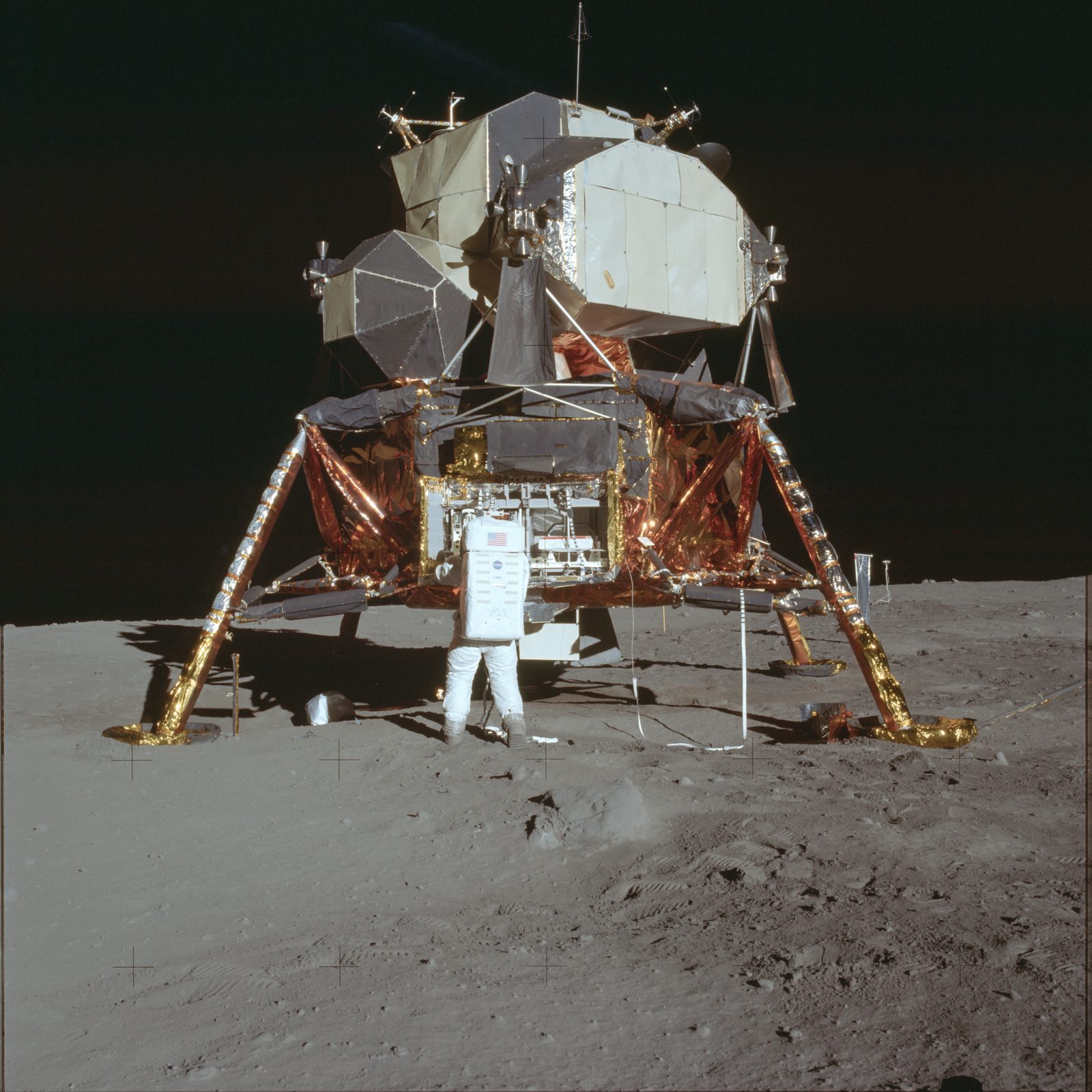
Apollo 11 returned the first samples of another world. The collection followed a deliberate sequence defined in the Lunar Surface Operations Plan and carried out during the EVA:
- Contingency sample — about 1 kg of surface material scooped immediately after egress, before anything else, so that some lunar material would be aboard even if the EVA had to be aborted early. It went into a small Contingency Sample Return Container (CSRC) that the EVA Procedures have the crew stow in a pressure-garment leg pocket for exactly this purpose. Catalogued as soil 10010 within the ~1014 g contingency collection — the first sample of the Moon, grabbed into a Teflon bag and pocketed after Armstrong reached the surface (GET 109:37:08, ~12 min after the first step, before Aldrin descended) — it also yielded the small rocks later numbered 10021–10032, all from the area immediately in front of the LM.
- Bulk sample — a larger, less-selective fill of one sample-return container to guarantee a substantial quantity of lunar material.
- Documented sample — selectively collected material whose local context (location, surroundings) was photographed and noted, filling the second container, together with two core tubes driven into the regolith to capture the near-surface stratigraphy.
The crew used a simple set of hand tools — a box-shaped scoop, tongs, two core tubes, an extension handle, and a hammer — to gather the material, sealing it into Apollo Lunar Sample Return Containers (ALSRCs): aluminum “rock boxes” closed with a knife‑edge biting into soft indium metal (Teflon sheets protected the sealing surfaces until closing) to hold a near‑vacuum during return. The sample catalogue identifies ALSRC #1003 as the Bulk Sample container and ALSRC #1004 as the Documented Sample container, and its Tables 1–2 assign every sample to its container: the contingency bag 1,015 g (soil 10010/10033 plus rocks 10021–10032), the bulk box 14,897 g (the 10002 soil family plus twelve rocks, including 10046 and the 919-g 10057), and the documented box 5,923 g (twenty-five rocks, the two core tubes, and fines) — the full per-sample partition is in the provenance reconstruction. In total the mission returned 21,836 g as weighed there (the 1969 sources report round values from 20 to 22 kg — see the discrepancy ledger, B1–B4), drawn from the fine regolith and later numbered and curated at the Lunar Receiving Laboratory under quarantine.
The crew debriefing (§10) records how the collection actually went. The bulk sample took roughly double the planned time — Armstrong made “20 trips back and forth” out of the MESA’s deep shadow into sunlight (also moving away from the engine-plume contamination), trying to get “both a hard rock and ground mass in almost every scoopful.” (The trip count is memory: the Catalogue’s frame-by-frame film analysis counts nine trips and 22–23 scoop motions — a 1969-vintage memory-vs-record case; ledger D1.) The documented sample was cut short — only ~10 minutes were left — and the ground asked for the two core tubes, which dominated the time: hammered hard, each drove only ~6 inches into the soft-over-hard soil, denting the top, and one tube’s cap apparently came off on removal. Closing the sample-return boxes “took a lot more strength than I had expected,” made worse because the low gravity let the light, skidding box slide on a flexible table. The Mission Report explains the force (§16.3.3, via the anomaly register): the training containers had been worked in below the 32-lb limit, but the flight units were unexercised and the contractor’s cleaning had stripped the lubricant from the latch linkage — adding up to ~24 lb to the closing force; afterward the lubricant was burnished on, and delivered boxes closed at ≤25 lb. The Solar Wind foil crinkled on roll-up but went into its container easily.
What “documented” actually meant on Apollo 11: the Catalogue’s own narrative calls the second box’s rocks “approximately 20 selected, but unphotographed, grab samples” collected in the final ~3½ minutes of the EVA, after Houston’s brief collapsed to “anything else that you can throw into the box would be acceptable” (111:19:29) — Armstrong’s verdict on the loop: “carefully selected, if not documented, samples.” The result is an inversion of the plan’s intent: the emergency contingency grab is the best-located collection of the mission, the documented box the worst (provenance reconstruction; field geology). The Lunar Sample Compendium’s dossiers carry the same assignments — the bulk soil 10002 (5629 g, later split into 10084/10086) in ALSRC #1003, the contingency scoop as sample 10010.
Related
- Apollo 11 sampling tools and containers
- Apollo 11 EVA (first moonwalk)
- Apollo 11 EVA life-support and mobility equipment
- Apollo 11 lunar sample types
- Lunar regolith and soil mechanics
- Lunar sample numbering and curation
- Lunar quarantine and back-contamination
- Solar Wind Composition experiment (S‑080)
- Lunar field geology (Experiment S-059)
Sources
- Apollo 11 Lunar Surface Operations Plan
- Catalog of Apollo Lunar Surface Geological Sampling Tools and Containers (JSC-23454)
- Apollo 11 EVA Procedures (Final)
- Apollo 11 Preliminary Science Report
- Apollo 11 Lunar Sample Information Catalogue
- Apollo 11 Technical Crew Debriefing — Volume 1
- Apollo 11 Mission Report (MSC-00171)
- Apollo 11 Lunar Sample Compendium