Powered descent and landing
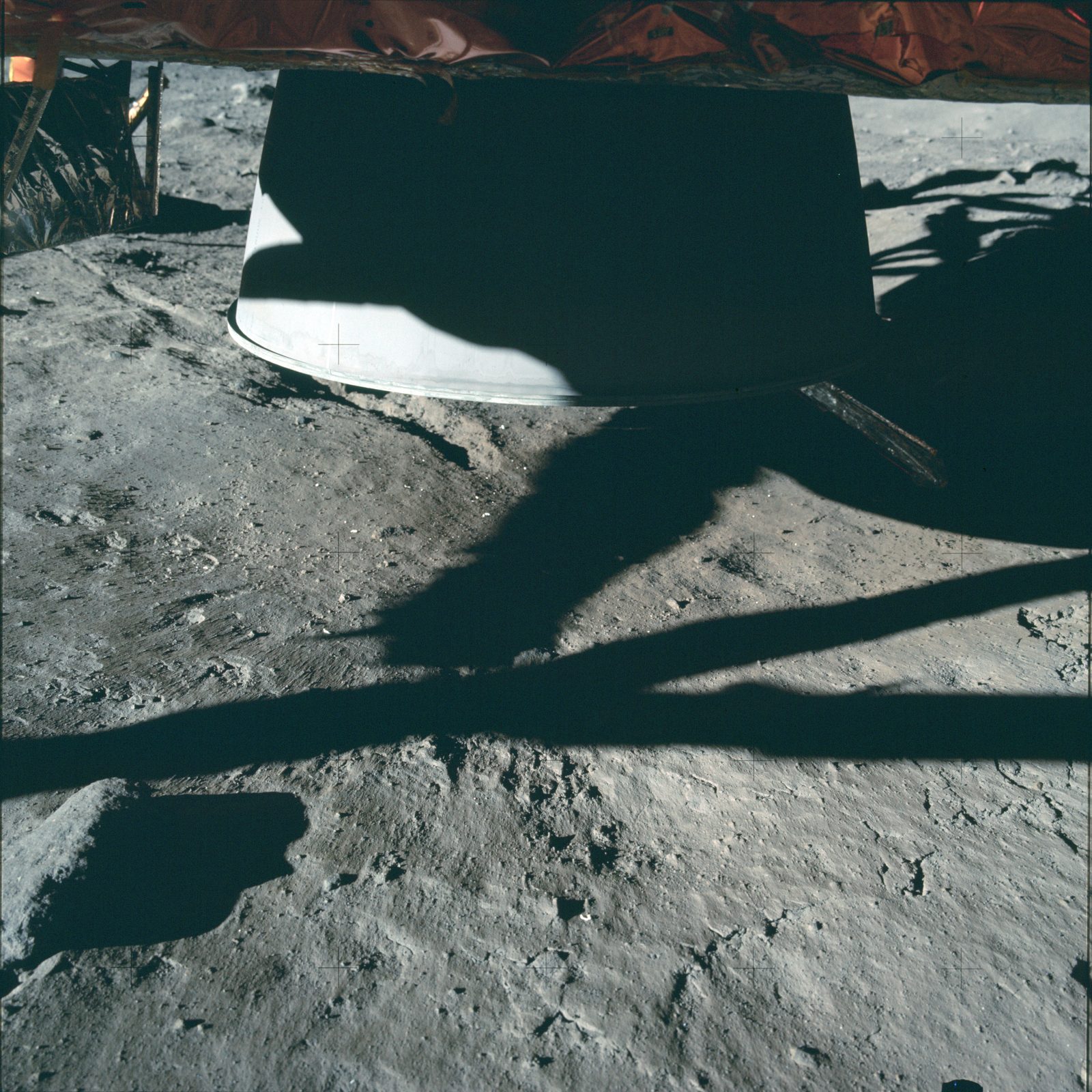
The powered descent was the maneuver that took the Lunar Module Eagle from its descent transfer orbit down to a soft landing at Tranquility Base. Per the Lunar Surface Operations Plan, the descent was initialized at pericynthion after LM/CSM undocking during the thirteenth lunar revolution. (The caution-and-warning system had already cried wolf on the way down the timeline: thruster warning flags lit before DOI and again minutes before powered descent, most likely a self-clearing signal-conditioner dropout — “the response of the vehicle to thruster firings would have been normal” — Mission Report §16.2.14, via the anomaly register.)
The air-to-ground transcript records the landing in real time. During the descent the guidance computer threw “1202” program alarms (executive-overflow warnings), which Mission Control cleared as GO. The final callouts capture the approach — “40 feet, down 2½. Kicking up some dust… Faint shadow…” — followed by “CONTACT LIGHT” and “ENGINE STOP” (ground elapsed time ~04 06 45 40). Moments later came the landing announcement: “Houston, Tranquility Base here. THE EAGLE HAS LANDED,” answered with “Roger, Tranquility. We copy you on the ground. You got a bunch of guys about to turn blue. We’re breathing again. Thanks a lot.” Immediately afterward the crew ran a simulated-countdown / stay‑no‑stay check of the LM’s launch capability before settling in for surface operations. (Provenance note: “CONTACT LIGHT” is a tagged, attributed line only in GOSS NET 1. The CM onboard (DSE) tape — Columbia’s recorder, taping the LM voices as received — is an independent second capture of these minutes that instead carries “SHUTDOWN” and cockpit-side lines the loop never did (“Pretty rocky area”, “Okay, how’s the fuel?”); see One moment, three records.)
In the crew debriefing (§9) Armstrong and Aldrin describe the descent from the cockpit: the program alarms began ~5 minutes in and “the concern here was… whether we could continue at all,” so attention was forced inside the cabin and they could not study the landing site until below ~2000 ft. Seeing that the computer was steering them into “a large rocky crater surrounded with… very large rocks,” Armstrong — who “initially felt that that might be a good landing area if we could stop short of that crater, because it would have more scientific value to be close to a large crater” — watched the LPD until it was obvious he could not stop short, then took manual control at ~P64, pitched over, and flew across the boulder field at 20–30 ft/sec looking for a clear spot. Below ~100 ft the engine raised blowing dust — “a thin layer of ground fog” moving fast — that obscured his sense of lateral and descent velocity (Aldrin: fix on the few “stationary… little islands” showing through it). They touched down with a slight left drift, near the abort fuel limit, settling “like a helicopter”; Armstrong never saw the contact light Aldrin called. The crew also noted the LM shadow as a useful descent cue, clearly visible ~260 ft out near touchdown.
The Mission Report quantifies the redesignation: in the final 2½ minutes Armstrong flew ~1100 ft downrange of the nominal aim point to clear that crater — afterward identified as West crater (~180 m across) — and Eagle came to rest tilted ~4.5° backward. (Stand-off distance: the Mission Report and the PSR’s geology chapter say “about 400 meters east,” but measurement on the 2011 LROC frame puts the descent stage ≈490 m from the rim crest and ≈575 m from the crater center — agreeing within ~40 m with the PSR’s soil-mechanics chapter (“approximately 130 m north and 600 m west”), one side of an internal 1969 conflict the measurement adjudicates; see the discrepancy ledger, entry A1.)
The fuel margin, exactly: the red-line low-level sensor light came on at 102:44:28 — 72 seconds before touchdown, bracketed by the only two things Houston said in the final two minutes (“60 seconds”; “30 seconds”) — and the Mission Report’s propellant ledger (§9.13.1) closes the account at 770 lb remaining at engine cutoff vs. 957 lb planned, against a preflight allowance of just 217 lb for exactly this redesignation-plus-manual-hover. The CM DSE tape also preserves the approach’s decision layer, which the air-to-ground loop never carried: Armstrong twice demanding a landing-point-designator angle seconds after the 1201 alarm (“Give me an LPD”), his terrain verdicts in sequence (“That’s not a bad-looking area” → “Pretty rocky area” → “this looks like a good area here”), and the descent’s only spoken fuel worry — “Okay, how’s the fuel?” at 102:43:57, 31 seconds before the light. (Braided second-by-second across all three records, with Mission Report Table 5-I, in The last three minutes.)
In his 2001 oral history — recollection three decades after the contemporaneous record above — Armstrong kept the same shape of the story with a calmer color. On the program alarms: “the computer said, ‘There’s a problem, and it’s not my fault’ … I would be in favor of continuing, no matter what the computer was complaining about.” On the auto-target area: “a fairly steep slope … covered with very big rocks … if I’d run out of fuel, why, I would have put down right there,” but with better ground “a half mile ahead or so … that’s where I went” — a distance grown in memory: the Mission Report’s redesignation is ~1100 ft, about a fifth of a mile. And on the fuel margin that transfixed the ground: with rates stabilized the LM could drop “perhaps maybe forty feet” onto its gear in 1/6 g — “I was perhaps probably less concerned about it than a lot of people watching down here on Earth.” (The 1969↔2001 comparison, including the dropped scientific-value motive, is drawn out in Memory vs. record.)
Related
- Lunar Module Eagle
- Tranquility Base (Landing Site 2)
- Apollo 11 EVA (first moonwalk)
- Lunar ascent and rendezvous
- GOSS NET 1 air-to-ground communications
- Apollo 11 mission
Sources
- Apollo 11 Technical Air-to-Ground Voice Transcription
- Apollo 11 Onboard Voice Transcription (CM DSE)
- Apollo 11 Lunar Surface Operations Plan
- Apollo 11 Technical Crew Debriefing — Volume 1
- Apollo 11 Mission Report (MSC-00171)
- Neil A. Armstrong — JSC Oral History (2001)