Lunar ascent and rendezvous
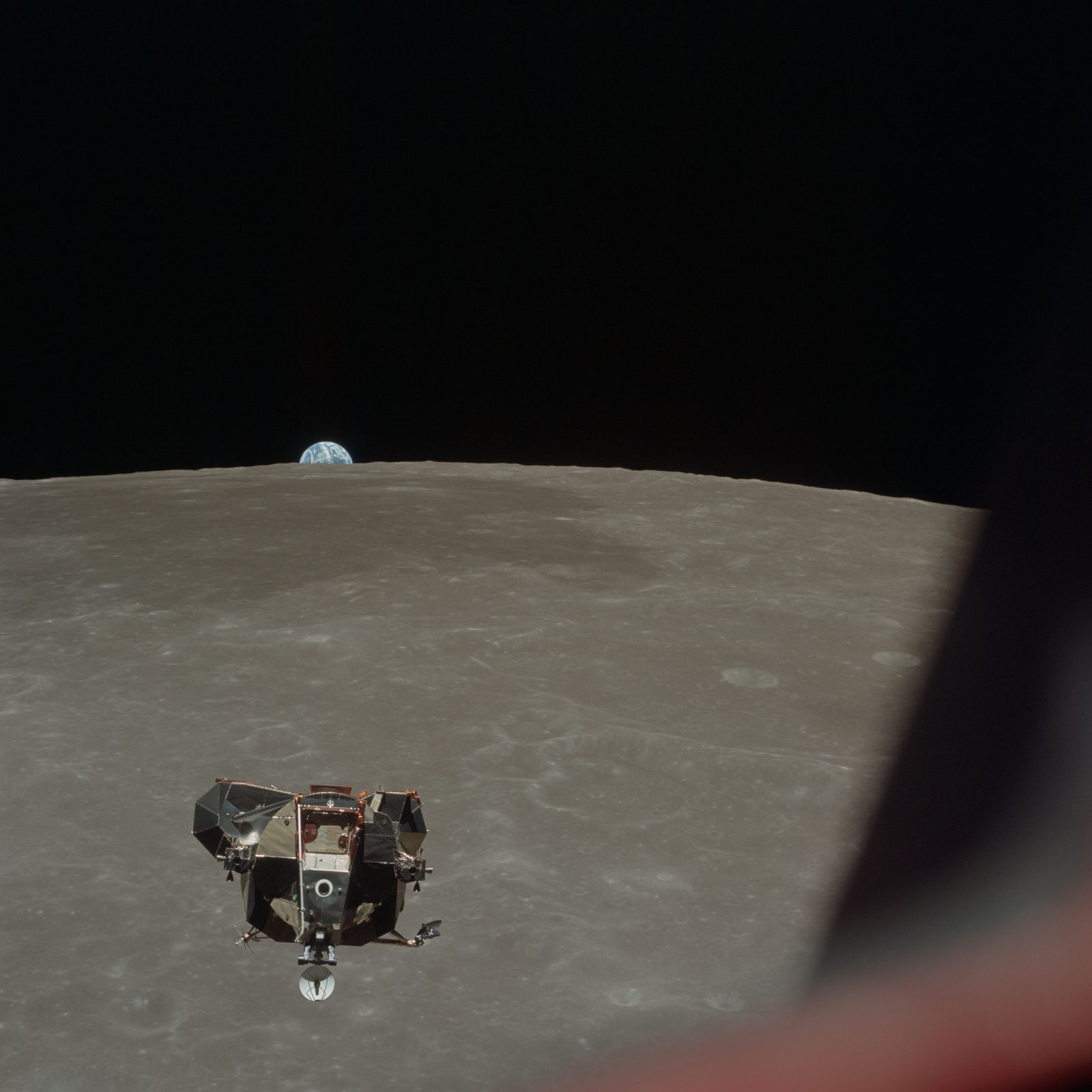
How Apollo 11 left the Moon — the mission’s single most failure-critical maneuver, since the Lunar Module Eagle carried one ascent engine with no backup. This concept closes the surface arc that powered descent and landing opened: after ~21½ hours at Tranquility Base and the EVA, the ascent stage lifted off, chased down Columbia in lunar orbit, and docked.
Liftoff
Section titled “Liftoff”Lunar liftoff was targeted for 124:22:00 GET and went almost exactly on time. (The premission plan in the Press Kit had set ascent-engine ignition at 124:23:21 GET — a 7 min 14 s burn of ~6,055 fps, vertical ascent for terrain clearance then orbital insertion — refined to the 124:22:00 liftoff time by flight day.) The crew armed the system and rode the computer up — Aldrin’s count in the air-to-ground transcript: “9, 8, 7, 6, 5, abort stage, engine arm ascent, proceed” … “Beautiful” … “26, 36 feet per second up. Be advised of the pitchover. Very smooth. Balance couple, OFF. Very quiet ride.” He added moments later, “A very quiet ride, just a little bit of slow wallowing back and forth. Not very much thruster activity.” The two guidance systems and the ground all tracked together — Houston: “PGNS, AGS, and MSFN all agree” — and the S-band held throughout.
The crew’s retrospective in the Technical Crew Debriefing Vol 2 (§12) matches the loop: at first motion there was “an appreciable bang of the PYRO’s and a fair amount of debris… tossed out,” then a smooth onset with no jolt — the ascent a gentle, “wallowing,” low-frequency Dutch-roll, “very pleasant” and far milder than the simulations had threatened. The fragile point on the surface had been the ascent-engine-arm circuit breaker, which Mission Control specifically re-checked before liftoff (“the circuitry looks real fine on that ascent engine arm circuit breaker”).
Rendezvous and docking
Section titled “Rendezvous and docking”Eagle flew the standard coelliptic rendezvous to catch Columbia: insertion into a low orbit, then the CSI (coelliptic sequence initiation, ~125:19 GET), CDH (constant delta-height), and TPI (terminal phase initiation, ~126:57 GET) burns, while Collins — who had spent the solo hours on P22 landmark tracking trying to spot the LM — flew the passive role from the command module. After braking and station-keeping the two craft docked, the surface crew transferred back into Columbia with the film and rock boxes, and the spent ascent stage was jettisoned in lunar orbit. From there the return home — transearth injection, coast, entry, and recovery into quarantine — was Columbia’s job.
The ride up collected its own cluster of minor anomalies (Mission Report §16, via the anomaly register), all benign: once in orbit, water spurted into Armstrong’s suit “at about 1-minute intervals” until the secondary water separator was selected (a binding selector valve, §16.2.13), and the same loose water wetted the CO₂ sensor’s optics, sending its reading high and erratic (§16.2.3); a dead display segment on the AGS’s DEDA made 3 and 9 ambiguous on one digit (§16.2.7); and in the 18 minutes before TPI a contaminated thrust-chamber pressure switch ignored seven straight minimum-impulse commands, flashing a master alarm at a quad whose engine “operated normally” (§16.2.12).
Armstrong’s recollection (2001)
Section titled “Armstrong’s recollection (2001)”Thirty-two years on, Armstrong’s oral history added a pilot’s footnote the simulators had missed: ascent acceleration began below ~½ g — “kind of a slow ascent” — and because pitch control fired down-pointing thrusters only (up-firing jets would fight the climb and waste propellant), the LM rode with “a substantial rocking motion … as though you’re in a rocking chair.” “We knew this, but the simulators never included this in their representation of the motions” — the considered echo of the debriefing’s contemporaneous “slow wallowing” description.
Related
- Powered descent and landing
- Lunar Module Eagle
- Command and Service Module Columbia
- Apollo 11 EVA (first moonwalk)
- Tranquility Base (Landing Site 2)
- GOSS NET 1 air-to-ground communications
- Apollo 11 mission
Sources
- Apollo 11 Technical Air-to-Ground Voice Transcription
- Apollo 11 Technical Crew Debriefing — Volume 2
- Apollo 11 Mission Report (MSC-00171)
- Apollo 11 Press Kit (Release 69-83K)
- Neil A. Armstrong — JSC Oral History (2001)