Apollo 11 EVA life-support and mobility equipment
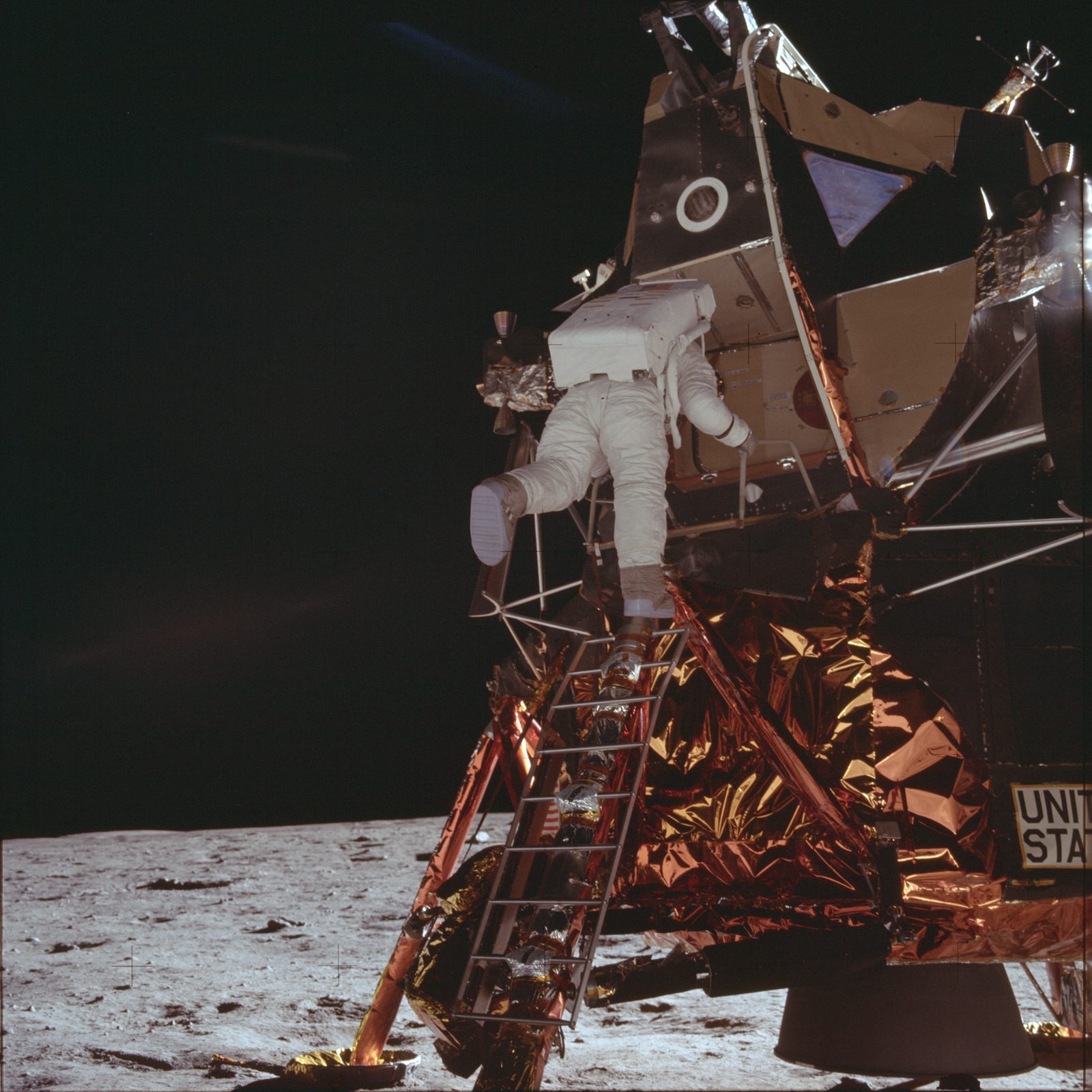
Walking on the Moon required the crew to become self-contained spacecraft. The EVA Procedures are organized around a small set of life-support and mobility hardware that the astronauts donned inside the Lunar Module before depressurizing the cabin:
- PGA — Pressure Garment Assembly: the pressurized suit itself, worn over the liquid-cooled garment, sealed by a zipper that the checklist has the crew inspect and “verify lock-lock.” It holds a working pressure of about 3.85 psia and carries leg and arm pockets used to stow items such as the contingency sample container.
- PLSS — Portable Life Support System: the backpack that supplies oxygen, cooling water, and communications during the EVA. The procedures cover donning it at the upper docking station, connecting its electrical umbilical to the PGA, managing its feedwater shutoff valve and cooling diverter at hatch opening, and — in the contingency set — recharging it in the LM for a second excursion.
- OPS — Oxygen Purge System: an emergency oxygen pack (≈5880 psia O₂) mounted atop the PLSS that provides a backup supply; it is the primary life support for the orbital contingency transfer EVA between the LM and the Command Module.
- LEVA / RCU / EV gloves and visor: the Lunar Extravehicular Visor Assembly, the chest-mounted Remote Control Unit, and the overgloves and overvisor that complete the extravehicular configuration.
- LEC — Lunar Equipment Conveyor: a pulley “clothesline” rigged to the overhead handhold to lower and raise equipment (cameras, sample containers) through the forward hatch.
The same hardware drove the mission’s egress choreography: don PLSS/OPS, depress the cabin, open the forward hatch, lower equipment on the LEC, and — at the end — jettison the PLSSs, OPS brackets, ECS canister, and armrests out the hatch to save ascent-stage mass before repressurizing. The final seal was two-man work by design: the LM Lunar Surface Checklist (SUR-33) has each crewman place and lock the other’s helmet — Armstrong seals Aldrin, Aldrin seals Armstrong — before LEVAs and EV gloves go on “and ‘lock.’” The science hardware was carried separately in the LM’s SEQ bay (the EASEP packages) and MESA (tools and TV).
The crew debriefing (§10) is largely an equipment critique. The worst offender was the RCU-to-PLSS connector — “about a 50-pin Bendix connector” — which took ~10 minutes each to mate on the surface, a problem the crew had complained about “for 2 years or more” and judged serious enough to “jeopardize the success of an EVA.” Working with the PLSS on the back in the cramped cabin, they broke one circuit breaker and depressed two others, a risk to the LM’s integrity — the Mission Report (§16.2.11) identifies the broken knob as the engine-arm breaker’s, attributes the impact to the OPS’s aft edge during EVA prep (the damage was discovered only after the EVA; the breaker still closed for ascent), and fitted breaker guards from Apollo 12. Cabin depressurization through the bacteria filter — with the PLSS adding gas and the sublimator slow to start an ice cake — took ~30 minutes and had never been run end-to-end on the ground. On suit cooling, Armstrong ran minimum flow almost throughout (lower flow than expected sufficed), while Aldrin preferred more; the crew learned only in hindsight that higher diverter cooling drives higher feedwater consumption. SP-368 sharpens the contrast: on the Apollo 11-era PLSS the diverter valve supplied cooling water at ~21 °C (min), ~15 °C (intermediate), and ~7 °C (max), and Aldrin was the only crewman of the program who frequently used the maximum position — consistent with his locomotion-evaluation workload (see crew health and biomedical performance). The LEC was “a great attractor of lunar dust,” raining powder into the cabin and binding in its pulley until “we all looked like chimney sweeps.”
The Mission Report (§10) rates overall extravehicular mobility unit performance as excellent, with lower-than-expected metabolic rates during the surface work — the suits kept the crew comfortable with margin to spare.
Related
- Apollo 11 EVA (first moonwalk)
- Crew health and biomedical performance on Apollo 11
- Lunar surface mobility in one-sixth gravity
- Apollo 11 contingency EVA procedures
- Lunar Module Eagle
- Lunar sample collection and containers
- Apollo 11 sampling tools and containers
- Lunar quarantine and back-contamination
Sources
- Apollo 11 EVA Procedures (Final)
- Apollo 11 LM Lunar Surface Checklist (LM-5)
- Apollo 11 Technical Crew Debriefing — Volume 1
- Apollo 11 Mission Report (MSC-00171)
- Biomedical Results of Apollo (NASA SP-368)