Laser Ranging Retroreflector (S-078)
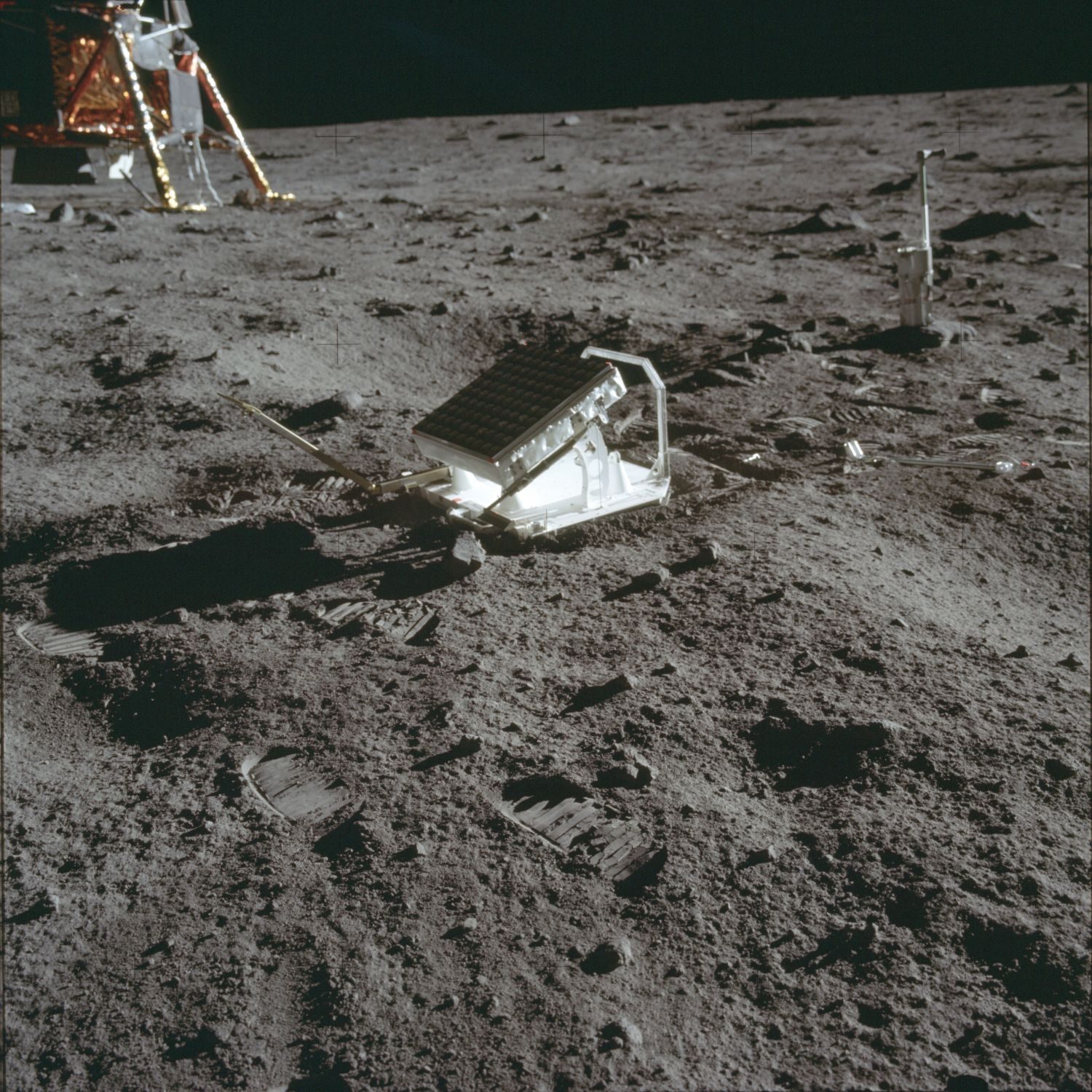
The Laser Ranging Retroreflector (experiment number S‑078, “Laser Ranging Retro‑Reflector,” LRRR) was a passive optical instrument deployed during the Apollo 11 EVA as part of EASEP. It is an array of corner-cube reflectors that returns a laser pulse fired from Earth straight back toward its source, allowing the Earth–Moon distance to be measured with high precision by timing the round trip.
The principal investigator was Dr. C. O. Alley of the University of Maryland. The EASEP Handbook describes a panel of 100 corner-cube reflectors with an aim-angle handle, leveled and oriented in azimuth on the surface with an alignment handle, gnomon shadow, and bubble level. Because the speed of light is known and round-trip times can be measured to billionths of a second, the experiment was designed to fix the Earth–Moon distance to within about 15 cm over time spans up to 10 years, supporting study of fluctuations in Earth’s rotation rate, the wobble of Earth on its axis, the Moon’s size and orbit, and any slow secular change in the gravitational constant G.
Unlike the powered experiments, the retroreflector needs no electrical power and does not wear out, so — as the Preliminary Science Report anticipated — it continues to be usable for months and years after deployment. Long-baseline laser ranging to such reflectors supports measurements of lunar librations, the lunar orbit, and tests of gravitational physics.
Aldrin pulled the LRRR (the second EASEP package) from its boom with the same technique as the seismometer — a firm jerk on the pip-pin lanyard, which sprang its wire ring open, possibly weakened by thermal effects. Of the emplacement itself, Armstrong’s verdict in the crew debriefing (§10.40) was simply: “There was no difficulty in the laser reflector installation. It worked as we expected.”
The Mission Report (§11.5) notes the reflector immediately supported precision Earth–Moon ranging from the McDonald Observatory, the technique’s first lunar target. The principal investigators’ retrospective (Bender et al. 1973) fills in the sequence: after early attempts were frustrated by the low Moon, landing-site uncertainty, and weather, the first strong returns came at Lick Observatory on August 1, 1969 (range checked to 7 m), with high-confidence McDonald returns days later. The experiment itself had been rushed onto Apollo 11 as a contingency when the full ALSEP proved too heavy for the first landing — passive, reliable, and quick to deploy (see EASEP). What the array went on to deliver — centimeter ranging, the Moon’s measured recession, relativity tests — is told in lunar laser ranging: results and legacy.
Related
- Lunar laser ranging: results and legacy
- Early Apollo Scientific Experiments Package (EASEP)
- Passive Seismic Experiment (S‑031)
- Solar Wind Composition experiment (S‑080)
- Apollo 11 EVA (first moonwalk)
- LROC imaging of the Apollo 11 landing site
Sources
- EASEP Handbook for Apollo 11 Flight Crew
- Apollo 11 Preliminary Science Report
- Apollo 11 Lunar Surface Operations Plan
- Apollo 11 Technical Crew Debriefing — Volume 1
- Apollo 11 Mission Report (MSC-00171)
- LROC NAC imagery of the Apollo 11 landing site
- The Lunar Laser Ranging Experiment (Bender et al., 1973)