Solar Wind Composition experiment (S-080)
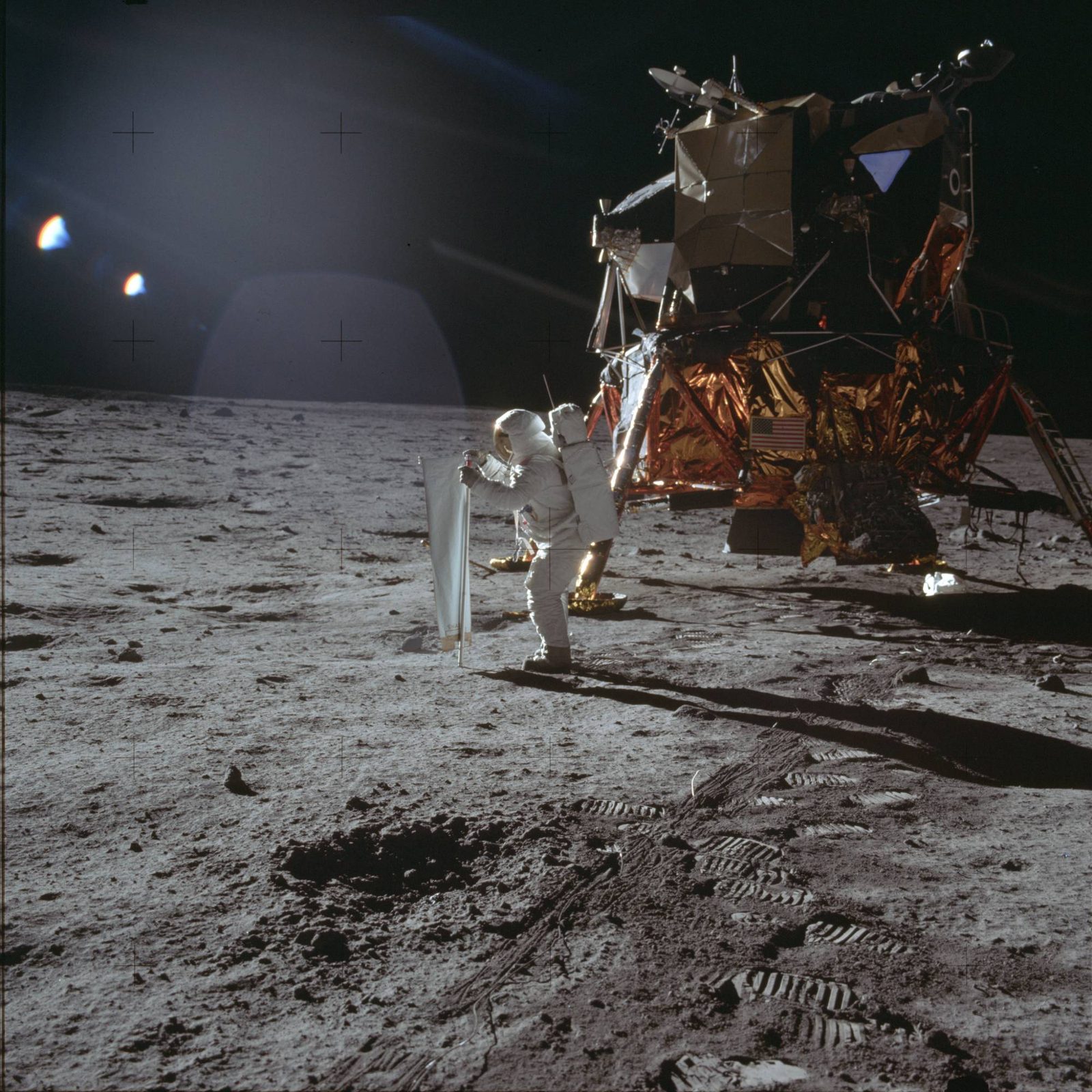
The Solar Wind Composition experiment (experiment number S‑080, SWC) was a separate experiment set out during the EVA alongside the EASEP instruments — and the simplest piece of surface science on the mission: a sheet of high-purity aluminum foil (the EASEP Handbook specifies 1.5 mil thickness on a telescoping staff) mounted on a pole and exposed to space, facing the Sun, so that ions of the solar wind would embed in it. It was the first experiment deployed on the surface — the handbook has the LMP set it up while the CDR rigs the TV — to maximize exposure time. Afterward the foil was rolled up, sealed in a Teflon bag inside a sample-return container, and brought back to Earth, where the trapped noble gases (helium, neon, argon, krypton, xenon) were extracted by mass spectrometry. The experiment was led by Dr. Johannes Geiss of the University of Berne.
As reported in the Preliminary Science Report, analysis of the returned foil detected solar-wind noble gases directly and measured their isotopic composition — confirming that the solar wind is predominantly protons and providing a direct sample of solar composition. This complemented the finding that the lunar fines and breccias are themselves loaded with implanted solar-wind rare gases (~0.1 cc/g), accumulated over long exposure of the regolith to the solar wind.
Aldrin’s account in the crew debriefing (§10.36) confirms the foil deployed easily — the telescoping shaft “extended and locked back into position very easily,” and the staff pushed “about 4 or 5 inches” into the soil before it turned hard. The shadow the staff cast on the surface served as a handy check that the foil was mounted perpendicular to the Sun. At retrieval the foil “had a tendency to sneak off to the side and crinkle on the edges” as it rolled up; remembering the foil would be cut up anyway, Armstrong simply bunched it together and it slid into its container.
The Mission Report records the foil’s 0.4 m² effective area and that it was deployed ~6 m from the LM.
Related
- Early Apollo Scientific Experiments Package (EASEP)
- Passive Seismic Experiment (S‑031)
- Laser Ranging Retroreflector (S‑078)
- Apollo 11 lunar sample types
- Surface exposure and space weathering (Apollo 11 samples)
Sources
- EASEP Handbook for Apollo 11 Flight Crew
- Apollo 11 Preliminary Science Report
- Apollo 11 Lunar Surface Operations Plan
- Apollo 11 Technical Crew Debriefing — Volume 1
- Apollo 11 Mission Report (MSC-00171)