Lunar regolith and soil mechanics
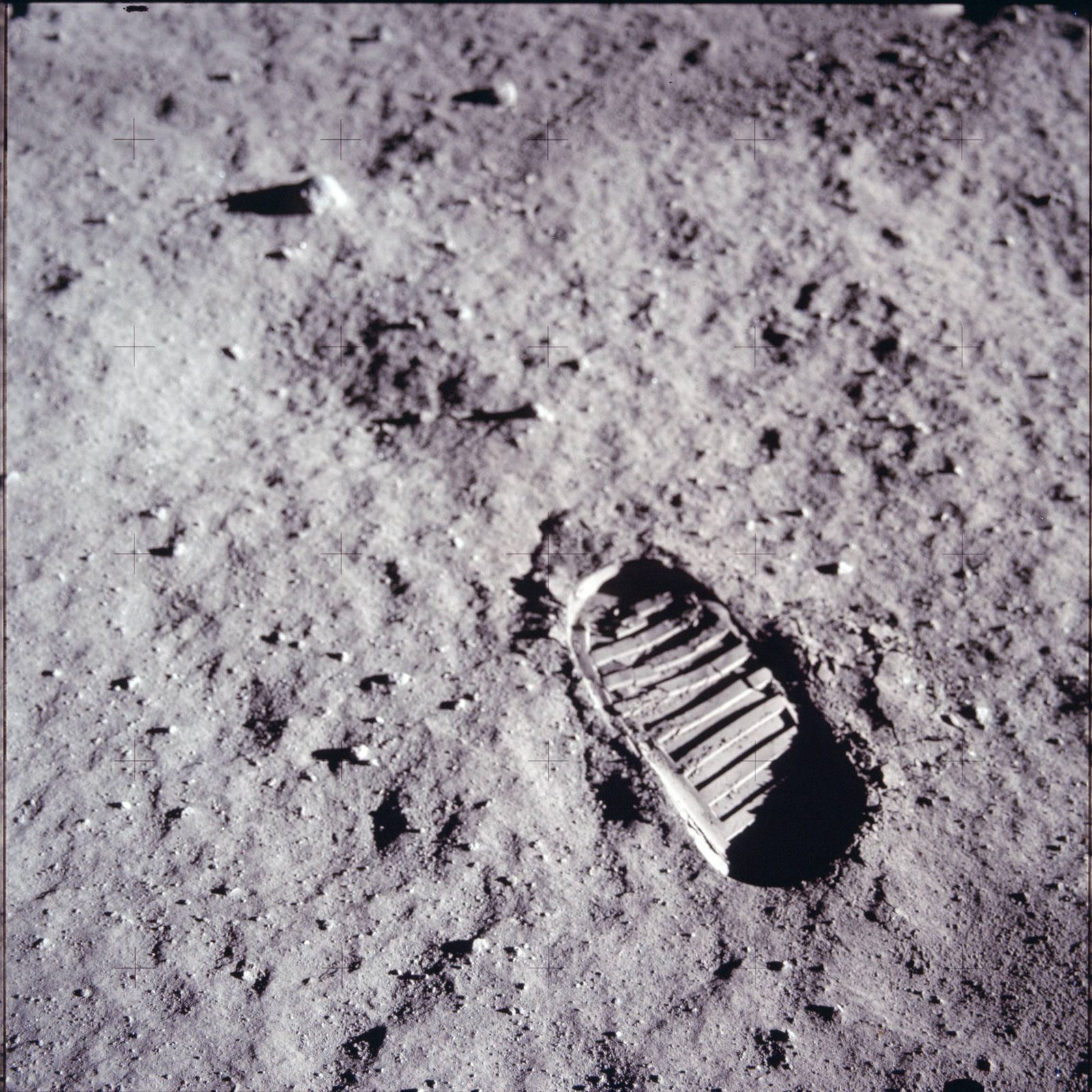
The Apollo 11 site at Tranquility Base is mantled by the regolith — a layer of unsorted fragmental debris, from blocks ~1 m across down to microscopic particles, produced by the prolonged bombardment of the bedrock by impacts. The Preliminary Science Report’s geologic investigation (Shoemaker et al.) estimates this debris layer is approximately 5 m thick at the site. The lunar module set down west of West Crater, a sharp-rimmed blocky crater ~180 m across whose ejecta rays extend past the landing site (≈490 m from its rim by later orbital measurement — the 1969 reports’ “~400 m” is one side of a record discrepancy); constant micrometeoroid “gardening” also leaves the exposed rocks pitted with tiny hypervelocity-impact craters.
The report’s separate soil mechanics investigation (Costes, Carrier, Mitchell, and Scott) inferred the regolith’s mechanical behavior from how it responded to the crew and hardware: the depth of the astronauts’ footprints and the penetration of the LM landing gear correspond to low static bearing pressures (~1 psi); the surface was relatively soft to depths of ~5–20 cm, below which resistance to penetration increases considerably (as also felt when driving the core tubes). The soil is weakly cohesive — able to stand on near-vertical slopes and to hold sharp footprint impressions — and broadly resembles the material found earlier at the robotic Surveyor landing sites. This same fine material is the type D “fines” that dominate the returned samples and that carry implanted solar-wind gases.
The crew debriefing (§10) confirms this soft-over-hard structure from the surface: the soil took the Solar Wind staff and the flagstaff “about 4 or 5 inches” easily and then “gets hard quickly,” and the core tubes would drive only ~6 inches even when hammered. Aldrin found the core material at depth surprisingly cohesive, with “the cohesive property that wet sand would have” — “a descriptive phrase, this was moist material” — that held together once cut. The fine surface powder was “graphite-like,” adhered to everything, and made rocks slippery underfoot; combined with a top layer whose softness varied unpredictably with small changes in topography, it gave the crew “a low confidence level in our balance and footing.”
The Mission Report (§11.1) brackets the regolith at 3–6 m thick from the depths of nearby craters; the slow reworking of this airless layer is why the astronauts’ disturbed-regolith trails still read as dark lanes in orbital images decades later.
The returned soils themselves are detailed in the Lunar Sample Compendium: 10084 is the canonical, exhaustively studied mature mare soil — rich in impact-welded agglutinates and implanted solar-wind gases — alongside the bulk soil 10002 and the coarse fines 10085. By the magnetic maturity index the Apollo 11 soils are mature (Iₛ/FeO ≈ 75, e.g. the contingency soil 10010), reflecting long surface residence. Cosmic-ray exposure data in those entries also gauge how slowly the layer turns over: individual rock surface-residence ages run from tens to a few hundred Myr, while the regolith breccia 10060 — lithified ancient soil — records ~2.3 Gyr of exposure.
Related
- Tranquility Base (Landing Site 2)
- Apollo 11 lunar sample types
- Lunar sample collection and containers
- Apollo 11 sampling tools and containers
- High-titanium mare basalt
- Apollo 11 EVA (first moonwalk)
- Lunar surface mobility in one-sixth gravity
- LROC imaging of the Apollo 11 landing site
- Lunar field geology (Experiment S-059)
- Surface exposure and space weathering (Apollo 11 samples)
Sources
- Apollo 11 Preliminary Science Report
- Apollo 11 Technical Crew Debriefing — Volume 1
- Apollo 11 Mission Report (MSC-00171)
- Apollo 11 Lunar Sample Compendium