Ceremonial and symbolic surface activities
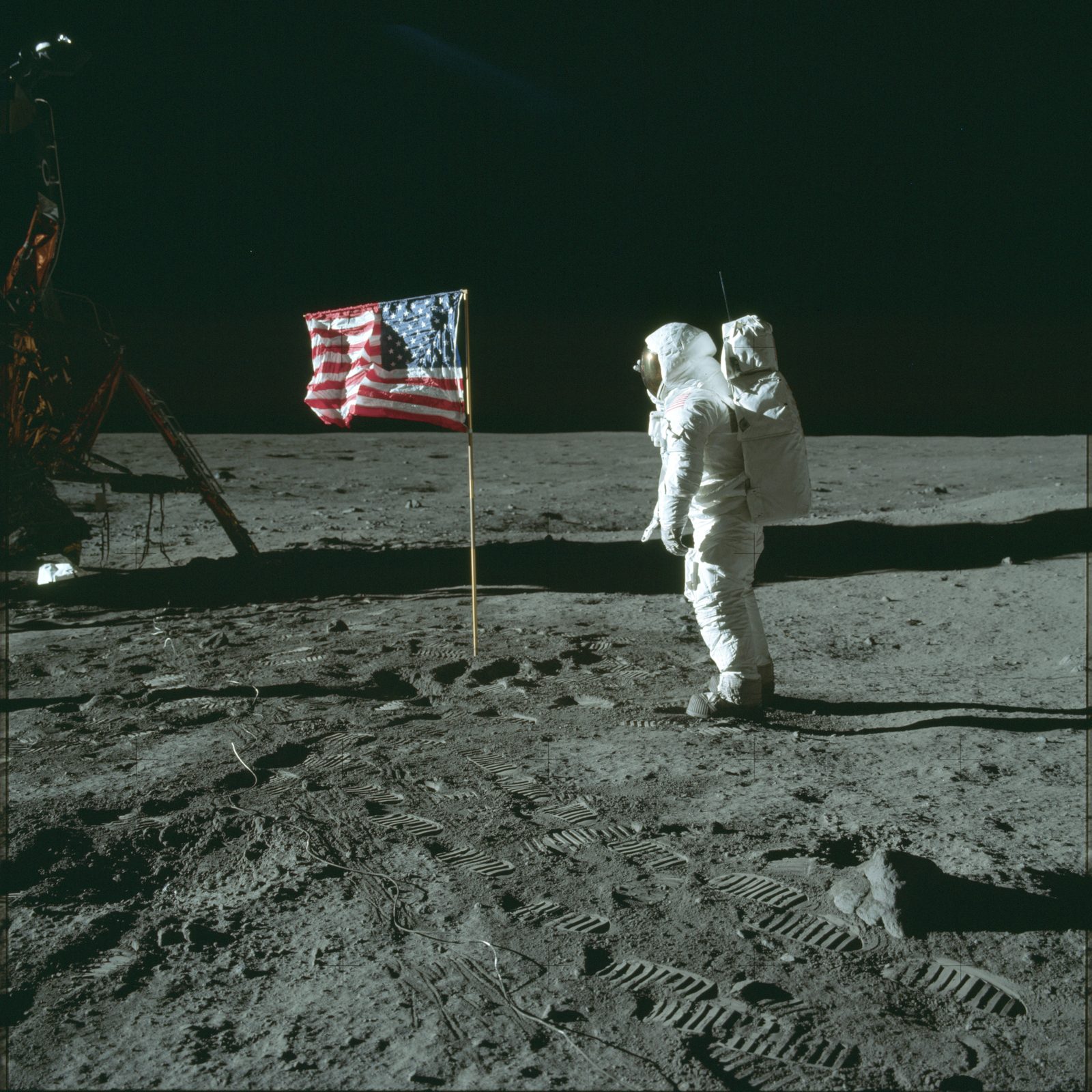
Alongside the sampling and the deployed experiments, the first moonwalk included a short sequence of symbolic acts — unveiling a plaque, planting the U.S. flag, and taking a call from the President — carried live to Earth by the television broadcast. They occupy only minutes of the timeline but are the most-remembered moments of the surface stay, and all three are in the verbatim air-to-ground transcript.
The plaque (~109:52 GET)
Section titled “The plaque (~109:52 GET)”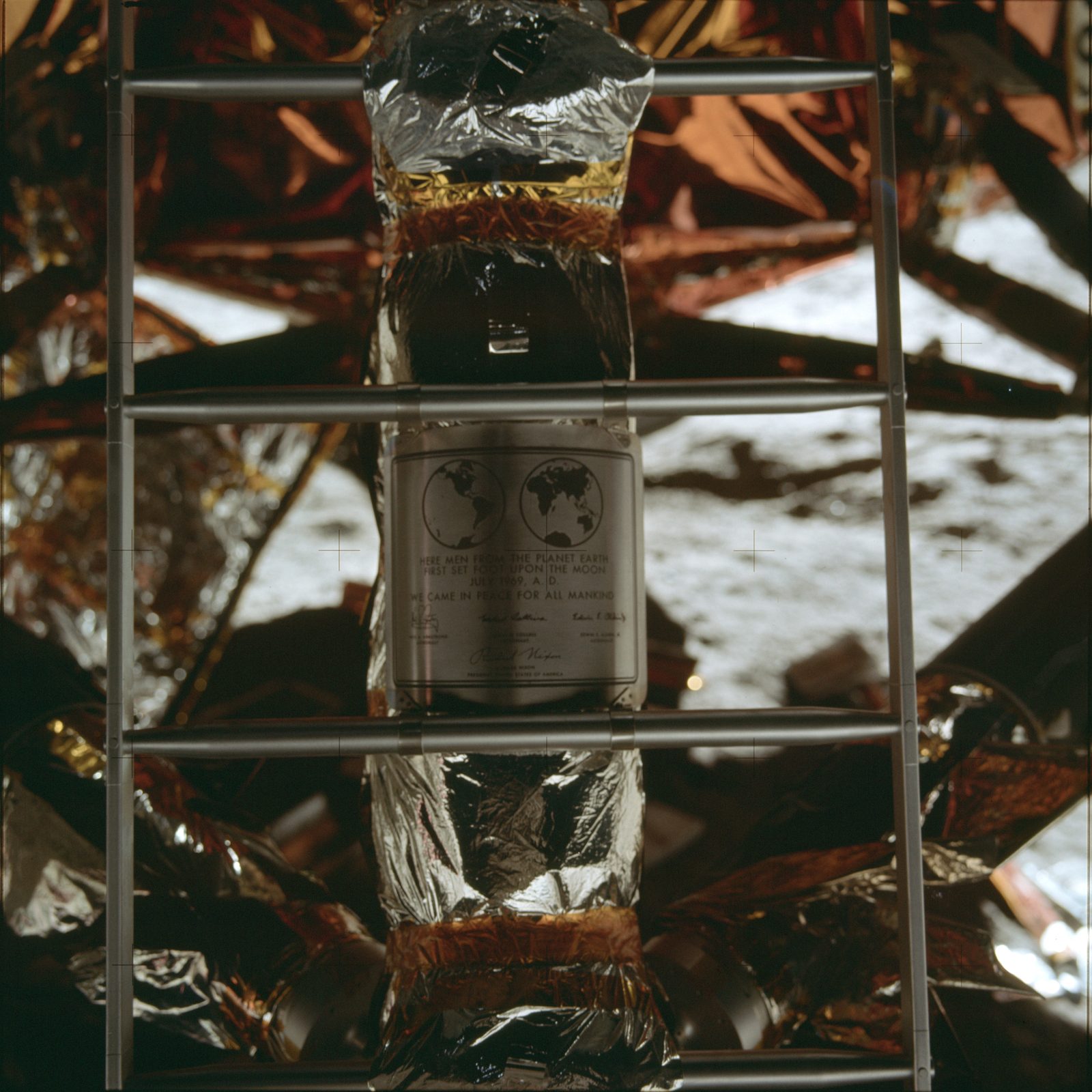
A stainless-steel plaque fixed to the descent stage’s front landing-gear strut — so it would remain on the Moon. Armstrong read it on the air: “Here Man from the planet Earth first set foot upon the Moon, July 1969 A.D. We came in peace for all mankind.” He described its two hemispheres of the Earth and noted it bore the three crew members’ signatures and the signature of the President of the United States. The pre-flight Press Kit gives the plaque’s as-designed inscription — “HERE MEN FROM THE PLANET EARTH FIRST SET FOOT UPON THE MOON. JULY 1969 A.D. WE CAME IN PEACE FOR ALL MANKIND” — so the plaque itself reads “men,” where the transcript rendered Armstrong’s spoken reading as the singular “Man.”
The flag (~110:09 GET)
Section titled “The flag (~110:09 GET)”Armstrong and Aldrin planted a U.S. flag held out by a horizontal rod (the lunar vacuum having no wind to fly it). Mission Control relayed the moment to Collins in Columbia: “They’ve got the flag up now and you can see the stars and stripes on the lunar surface.” Driving the staff into the dense, shallow regolith was difficult — consistent with the crew’s reports that the soil was firm a few inches down. Beyond the flag left on the surface, the crew also carried (and returned) two large U.S. flags and flags of the 50 states, D.C. and U.S. territories, of other nations, and of the United Nations (Press Kit).
The call from the President (~110:16 GET)
Section titled “The call from the President (~110:16 GET)”With both crewmen framed in the TV camera, Mission Control patched in a call from the White House: “Neil and Buzz, the President of the United States is in his office now and would like to say a few words to you.” Richard Nixon called it “the most historic telephone call ever made,” told them that “for one priceless moment in the whole history of man, all the people on this Earth are truly one,” and closed by looking forward to seeing the crew on the Hornet at recovery. Armstrong answered that the crew represented “not only the United States but men of peace of all nations.”
Armstrong’s 2001 oral history adds the actors’ view of two of these acts, decades later. On the flag: the choice of a U.S. flag over a U.N. flag was settled in Congress — “My job was to get the flag there. I was less concerned about whether that was the right” choice. And on his first words (spoken at the ladder, not in this ceremonial sequence, but of a piece with it): the line was composed after landing — “just something that was kind of passing around subliminally” — and was genuinely unscripted; NASA public affairs under Julian Scheer was “absolutely adamant” that crews were never told what to say. The famous dispute over the article is contemporaneous, not retrospective: the technical transcript flags it on the page — “ONE SMALL STEP FOR (A) MAN” — while the as-broadcast PAO record prints “for a man” as a matter of course (One moment, three records).
These activities competed with the science and sampling for the EVA’s tight time budget — part of why the moonwalk ran against its timeline. Notably, none of the three appears in the Lunar Surface Operations Plan’s nominal EVA timeline (even its June 27, 1969 revision), and the President’s call was a real-time insertion. The Mission Report’s Table 11-I books their cost as interruptions to the TV camera deployment and a +9-minute overrun on Aldrin’s “environmental familiarization” slot (“includes assisting Commander with plaque and television camera deployment”) — see planned vs. actual timeline.
Related
- Apollo 11 EVA (first moonwalk)
- Apollo 11 EVA planned vs. actual timeline
- Television broadcast and surface communications
- GOSS NET 1 air-to-ground communications
- Lunar Module Eagle
- Apollo 11 mission
Sources
- Apollo 11 Technical Air-to-Ground Voice Transcription
- Apollo 11 Mission Report (MSC-00171)
- Apollo 11 Spacecraft Commentary (PAO)
- Apollo 11 Lunar Surface Operations Plan
- Apollo 11 Press Kit (Release 69-83K)
- Neil A. Armstrong — JSC Oral History (2001)