Lunar seismicity and interior structure (PSE results)
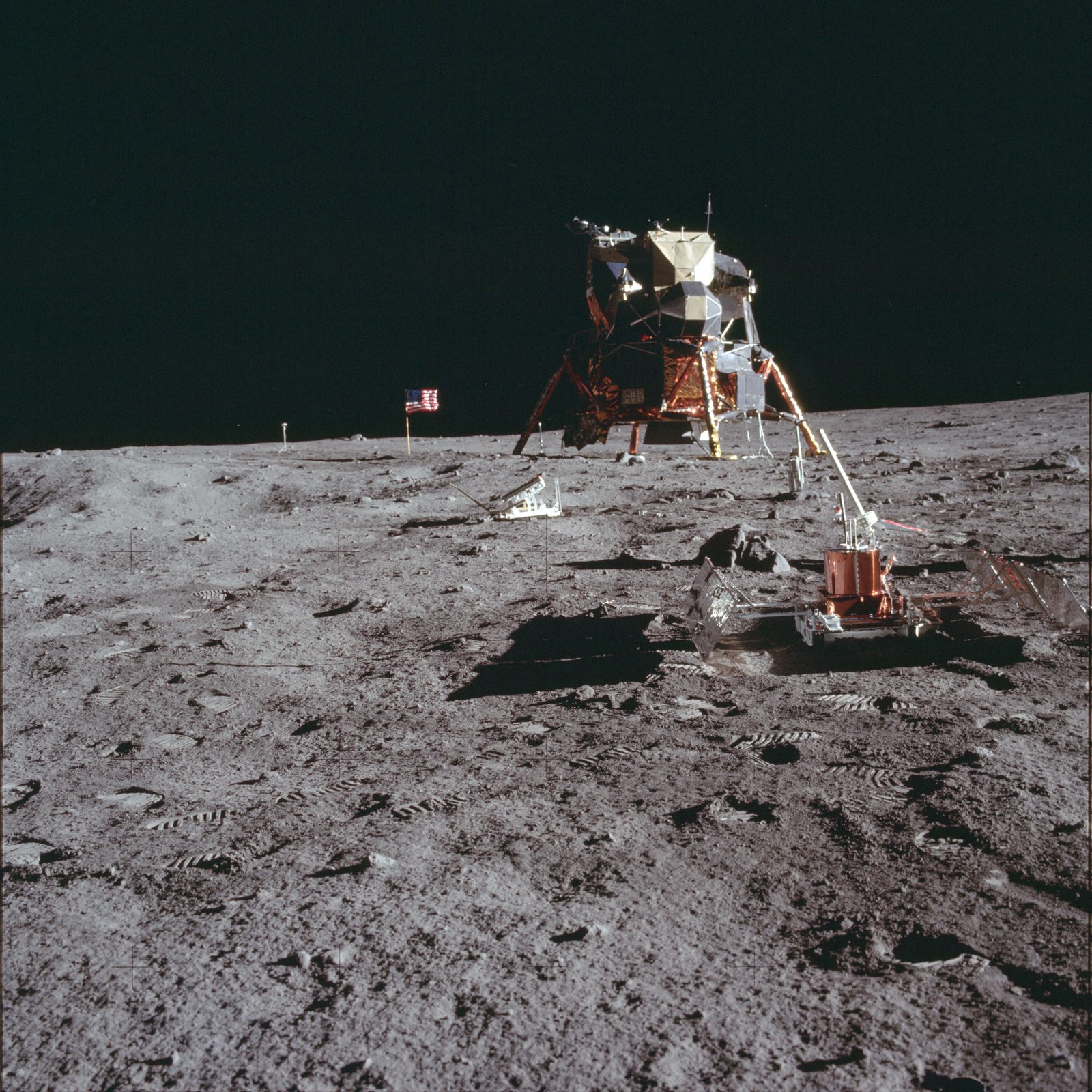
What the seismometers found — the results side of the Passive Seismic Experiment, from the PSE team’s network-era report (Latham et al. 1977). Apollo 11’s solar-powered station proved the technique and died in its first lunar night, by design a day-only instrument; the RTG-powered stations of Apollo 12, 14, 15, and 16 (the Apollo Seismic Network, completed April 1974) did the long listening. This is the article that lets the library say “the Moon is seismically quiet” with a citation.
The quiet Moon, quantified
Section titled “The quiet Moon, quantified”The lunar surface is so still that the instruments ran at ~20-million magnification — “two to three orders of magnitude higher than can normally be used on Earth” — resolving ground motions of about half an ångström. Total annual energy release from moonquakes is less than 10¹⁵ ergs per year, about nine orders of magnitude below Earth’s. The team’s own counterfactual: with instruments limited to terrestrial sensitivity, “we would have recorded no moonquakes at all” and concluded the Moon was devoid of internal activity (Latham et al.).
What actually shakes it
Section titled “What actually shakes it”- Deep moonquakes — numerous but tiny (maximum Richter magnitude ~2), concentrated in a thin zone at 600–800 km depth, with occurrence patterns showing tidal periodicities: “tides play a dominant role” in generating them.
- High-frequency shallow events — the largest natural signals recorded, but extremely rare: 11 identified in three years; candidate true “shallow moonquakes.”
- Thermal moonquakes — small near-surface events tracking the day–night temperature cycle (slumping or thermal-stress dislocations), possibly an erosional process in their own right (a companion to space weathering).
- Meteoroid impacts — several hundred registered per station per year; the deliberate Saturn S-IVB stage impacts served as calibration shots of known energy. (Apollo 11’s own seismometer caught the human version: the jettisoned PLSS backpacks thudding down.)
The interior the network revealed
Section titled “The interior the network revealed”Seismic structure showed a differentiated Moon: primitive differentiation of the outer shell to ~300 km; a crust of 40–80 km (anorthositic gabbro grading to gabbro) over an ~250-km-thick olivine–pyroxene cumulate; and — from shear waves going missing for far-side events — a central region presently molten to a radius of 200–300 km, with iron or iron sulphide the best core candidate. If accretional energy caused the early melting, the Moon must have accreted fast. This is the geophysical companion to what the samples established chemically: an ancient, differentiated world.
Apollo 11’s place in the story
Section titled “Apollo 11’s place in the story”The first station’s 21 days returned first-lunar-day data and proved deployment, leveling, uncaging, and telemetry on the Moon — the capability (PSE article); the network it pioneered delivered the science above. Together with the laser-ranging legacy, it is one of the two Apollo 11 experiments whose results outlived the mission by decades.
Related
- Passive Seismic Experiment (S‑031)
- Early Apollo Scientific Experiments Package (EASEP)
- First-order results of Apollo 11
- Lunar laser ranging: results and legacy
- Surface exposure and space weathering