Apollo 11 EVA (first moonwalk)
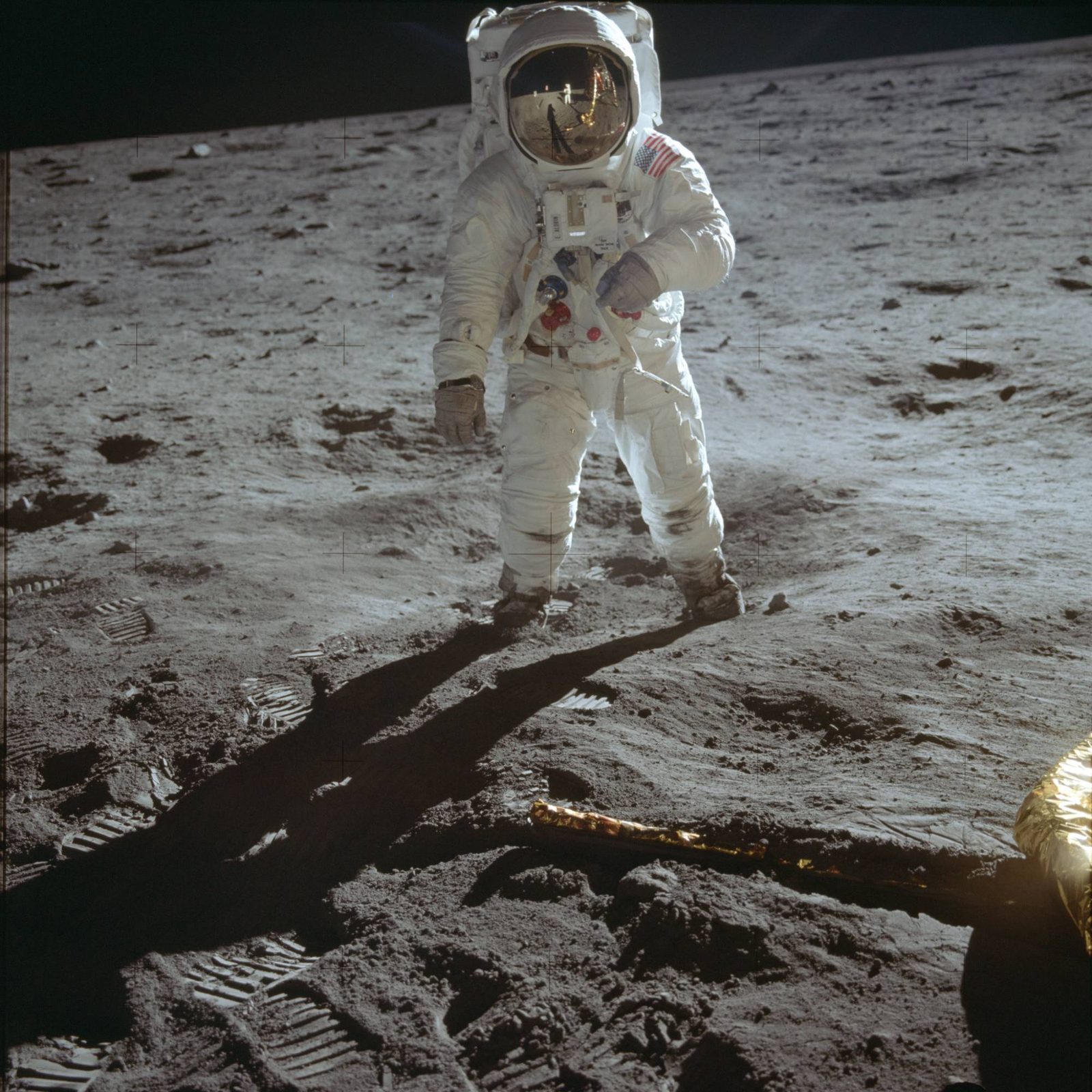
The Apollo 11 extravehicular activity was the first time humans walked on the Moon. The Lunar Surface Operations Plan scheduled a single two‑man EVA of about 2 hours 40 minutes within a ~22‑hour surface stay; the sample catalogue records roughly 2 hours 14 minutes of actual surface exploration time. The plan ordered the surface tasks by priority: cabin-window photography → contingency sample → EVA evaluation → LM inspection → bulk sample → deployment of the surface experiments (the EASEP instruments and the Solar Wind Composition foil) → documented sample.
As Armstrong descended the ladder — Mission Control: “Okay, Neil, we can see you coming down the ladder now” — he stepped onto the surface with the words recorded in the transcript as “THAT’S ONE SMALL STEP FOR (A) MAN, ONE GIANT LEAP FOR MANKIND.” He described the regolith as “fine and powdery… it does adhere in fine layers like powdered charcoal to the sole and sides of my boots,” and collected the contingency sample first in case of an early abort. Real-time television was provided early in the EVA via the LM steerable antenna, received through the Goldstone and Parkes 210‑foot antennas.
The cabin-side mechanics of getting outside are spelled out in the separate EVA Procedures (Final): donning the PLSS and OPS life-support gear, depressurizing the cabin, opening the forward hatch, lowering equipment on the lunar equipment conveyor, and — after ingress — jettisoning the backpacks and other gear out the hatch before repressurizing. Tellingly, that checklist’s surface section contains no tasks of its own: it simply reads “EVA — Reference Lunar Surface Operations Plan,” deferring the moonwalk timeline to the LSOP. The same document also carries the contingency EVA procedures held in reserve.
The crew’s own account in the Technical Crew Debriefing (§10) fills in how it actually went. They elected to start the EVA before the scheduled rest period because adaptation to 1/6 g was “very rapid and very pleasant” — the Mission Report (§4.12.2) times the decision at 104:40:00 GET and the start of EVA prep at 106:11:00, putting the moonwalk ~3½ hours ahead of the planned 112:30 depress slot. EVA prep ran about an hour long against its ~2-hour simulation estimate — not because the checklist was bad (“we did, in fact, follow it pretty much to the letter”) but because a real, cluttered cockpit forced dozens of small unplanned decisions; the troublesome RCU-to-PLSS connector and a ~30-minute cabin depressurization added more. Egress and ladder work matched the tank/aircraft simulations well, helped by two-man cooperation (“all the help… is money in the bank”). Once outside, moving in 1/6 g proved easy and the suit “offered very little impediment,” though getting down to the surface to use the hands was hard. Armstrong made the farthest traverse (~200–300 ft to a large crater). Afterward the crew slept poorly in the cold, light-filled cabin — suits and helmets on, Armstrong rigging a hammock from a waste tether.
The Mission Report tallies the result: about 47 lb (~21 kg) of samples collected and the surface exploration completed within the allotted 2½ hours, under a Sun that climbed only from ~14.5° to 16° during the moonwalk; its Table 11-I sets the planned timeline against what each task actually took — transcribed and analyzed in Apollo 11 EVA planned vs. actual timeline.
Physiologically the moonwalk ran cheap: program-wide, SP-368 found lunar-EVA metabolic rates lower than predicted, with the “overhead” work (egress, equipment offload, ingress, sample stowage) the costliest part — though Aldrin’s locomotion-evaluation task made his the highest average EVA metabolic rate of the entire program. The human-performance thread is gathered in crew health and biomedical performance.
Related
- Apollo 11 EVA planned vs. actual timeline
- Apollo 11 nominal mission timeline
- Apollo 11 EVA life-support and mobility equipment
- Crew health and biomedical performance on Apollo 11
- Lunar surface mobility in one-sixth gravity
- Apollo 11 contingency EVA procedures
- Lunar sample collection and containers
- Apollo 11 sampling tools and containers
- Early Apollo Scientific Experiments Package (EASEP)
- Solar Wind Composition experiment (S‑080)
- Tranquility Base (Landing Site 2)
- Powered descent and landing
- Lunar Module Eagle
- Apollo 11 mission
- LROC imaging of the Apollo 11 landing site
- Apollo 11 surface photography
- Television broadcast and surface communications
- Ceremonial and symbolic surface activities
- Lunar ascent and rendezvous
Sources
- Apollo 11 Lunar Surface Operations Plan
- Apollo 11 Flight Plan (Final, AS-506) — the scheduled task sequence and EVA GET brackets
- Apollo 11 EVA Procedures (Final)
- Apollo 11 Technical Air-to-Ground Voice Transcription
- Apollo 11 Lunar Sample Information Catalogue
- Apollo 11 Technical Crew Debriefing — Volume 1
- Apollo 11 Mission Report (MSC-00171)
- LROC NAC imagery of the Apollo 11 landing site
- Biomedical Results of Apollo (NASA SP-368)