Early Apollo Scientific Experiments Package (EASEP)
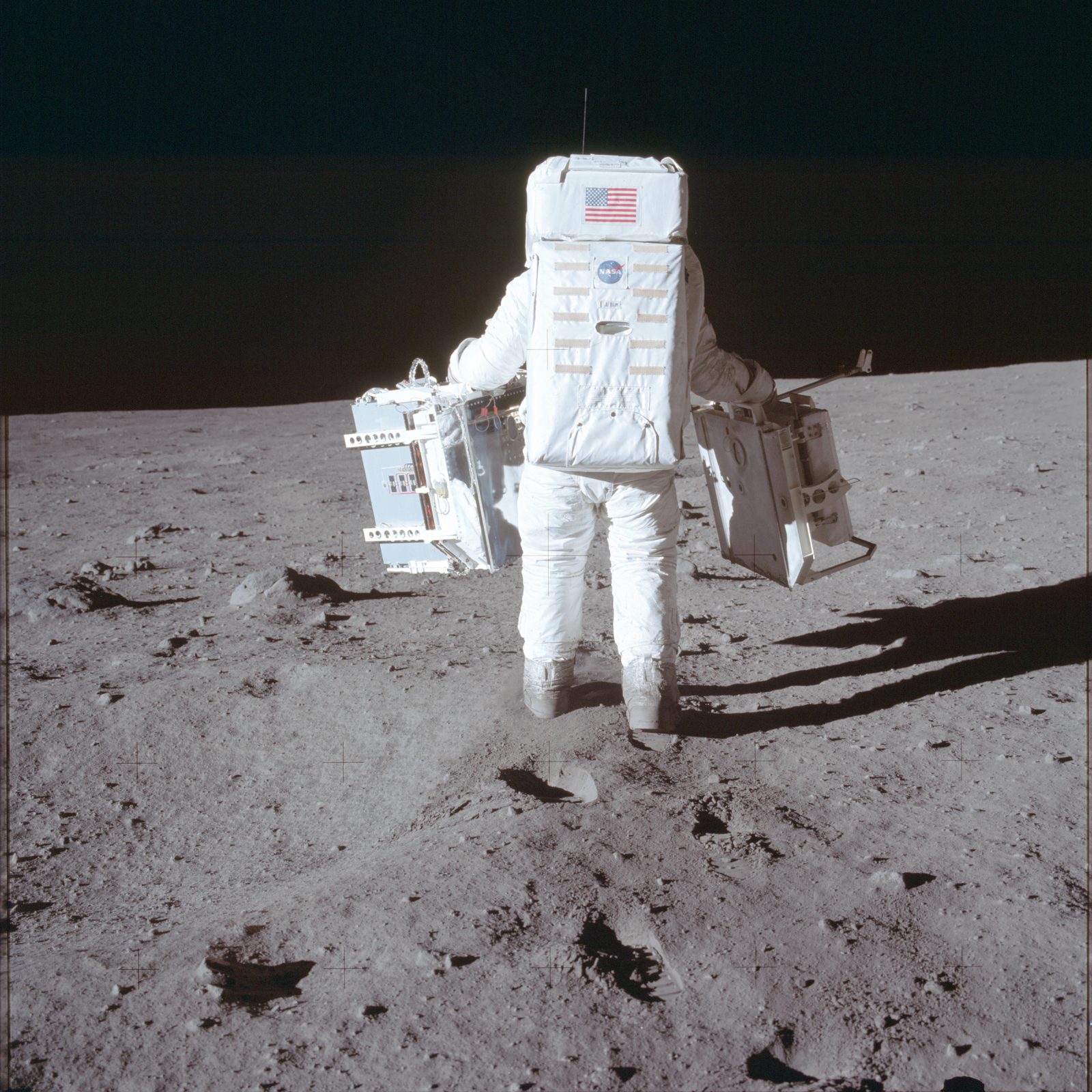
EASEP was the lightweight science package Apollo 11 deployed on the lunar surface during its single EVA. Because Apollo 11 was a short first landing, it carried this “early” package rather than the larger ALSEP flown on later missions. The laser-ranging principal investigators (Bender et al. 1973) date the decision: when word came in September 1968 that the astronaut workload on the first landing “might be too heavy to permit deployment of the planned ALSEP,” a proposal to fly the laser reflector as a contingency experiment was “quickly prepared” — favored for its science, the reliability of a completely passive instrument, and its very short deployment time. The Lunar Surface Operations Plan defines the resulting EASEP as two experiments:
- S‑031 — Passive Seismic Experiment: detected moonquakes and impacts to probe the lunar interior. Its package also carried a Modified Dust Detector — a small engineering experiment that monitored dust accumulation and radiation degradation of the solar cells (Preliminary Science Report, ch. 10).
- S‑078 — Laser Ranging Retroreflector: a passive optical reflector for precise Earth–Moon distance measurement.
A third surface experiment, S‑080 — Solar Wind Composition (an aluminum foil to trap solar-wind noble gases), was set out and retrieved during the same EVA, but the plan lists it alongside EASEP rather than as part of it. The EASEP Handbook confirms this framing — it defines the EASEP mission as the two self-contained PSEP and LRRR packages, with the SWC merely included in the handbook.
Two further experiments were assigned but were not part of the deployed surface package: S‑151 Cosmic Ray Detection (a passive experiment analyzed post-mission from the flight helmets) and T‑029 Pilot Describing Function. The deployed experiments’ first results are reported in the Preliminary Science Report.
Power and central station
Section titled “Power and central station”Only the PSEP carries active electronics; the LRRR and SWC are passive and need no power. From the EASEP Handbook:
- Electrical Power Subsystem (EPS): six solar panels of 420 cells each deliver 30–45 W to a Power Conditioning Unit, which converts the array’s 16 V to six operating voltages and radiates excess power to space via a shunt regulator to keep the package from overheating.
- Central Station: the PSEP’s data subsystem decodes uplink commands and transmits science/engineering telemetry to the Manned Space Flight Network through a redundant transmitter pair and a modified axial-helix S‑band antenna (right-hand circularly polarized), which the astronaut manually indexes to one of five possible lunar sites. A dust detector of three solar cells monitors dust accretion and radiation degradation.
Deployment
Section titled “Deployment”The handbook plans one-man deployment: the SWC is set out first; the PSE (Package 1) and LRRR (Package 2) are pulled from the LM’s SEQ bay on booms, carried ~70 ft from the LM (nominally south), and emplaced about 10 ft apart on cleared, level ground. Each is coarse-leveled within ±5° of vertical (an automatic gimbal fine-levels the seismometer) and aligned in azimuth within ±5° of lunar north/south using a gnomon shadow on a sun-compass rose; the PSEP must not face due east or west, and the crew must not walk up-sun of its solar panels. The “~70 ft” figure is independently corroborated from orbit: pixel measurement on the 2011 LROC NAC frame puts the two deployed packages ~24 m almost due south of the descent stage (Tranquility Base photo-map).
In the field (per the crew debriefing, §10.40), Aldrin pulled both packages off their booms manually to save time, carried them out toward the minus-Y strut, and set them on a ridge between shallow craters — there was no rock table, only soft soil he could jiggle them into. The hardest part was leveling: with a poor horizon and an aft-displaced center of mass in 1/6 g, “it was just a little bit difficult to tell what was level,” and the seismometer’s bubble level misbehaved. The gnomon shadow stood out well enough against the bright surface to set azimuth. Even so, the deployment ran slightly ahead of the timeline. Both packages are visible in later LROC orbital imagery, sitting south of the descent stage where Aldrin emplaced them.
Related
- Passive Seismic Experiment (S‑031)
- Laser Ranging Retroreflector (S‑078)
- Solar Wind Composition experiment (S‑080)
- Apollo 11 EVA (first moonwalk)
- Apollo 11 mission
- LROC imaging of the Apollo 11 landing site
Sources
- EASEP Handbook for Apollo 11 Flight Crew
- Apollo 11 Lunar Surface Operations Plan
- Apollo 11 Preliminary Science Report
- Apollo 11 Technical Crew Debriefing — Volume 1
- Apollo 11 Mission Report (MSC-00171)
- LROC NAC imagery of the Apollo 11 landing site
- The Lunar Laser Ranging Experiment (Bender et al., 1973)