Passive Seismic Experiment (S-031)
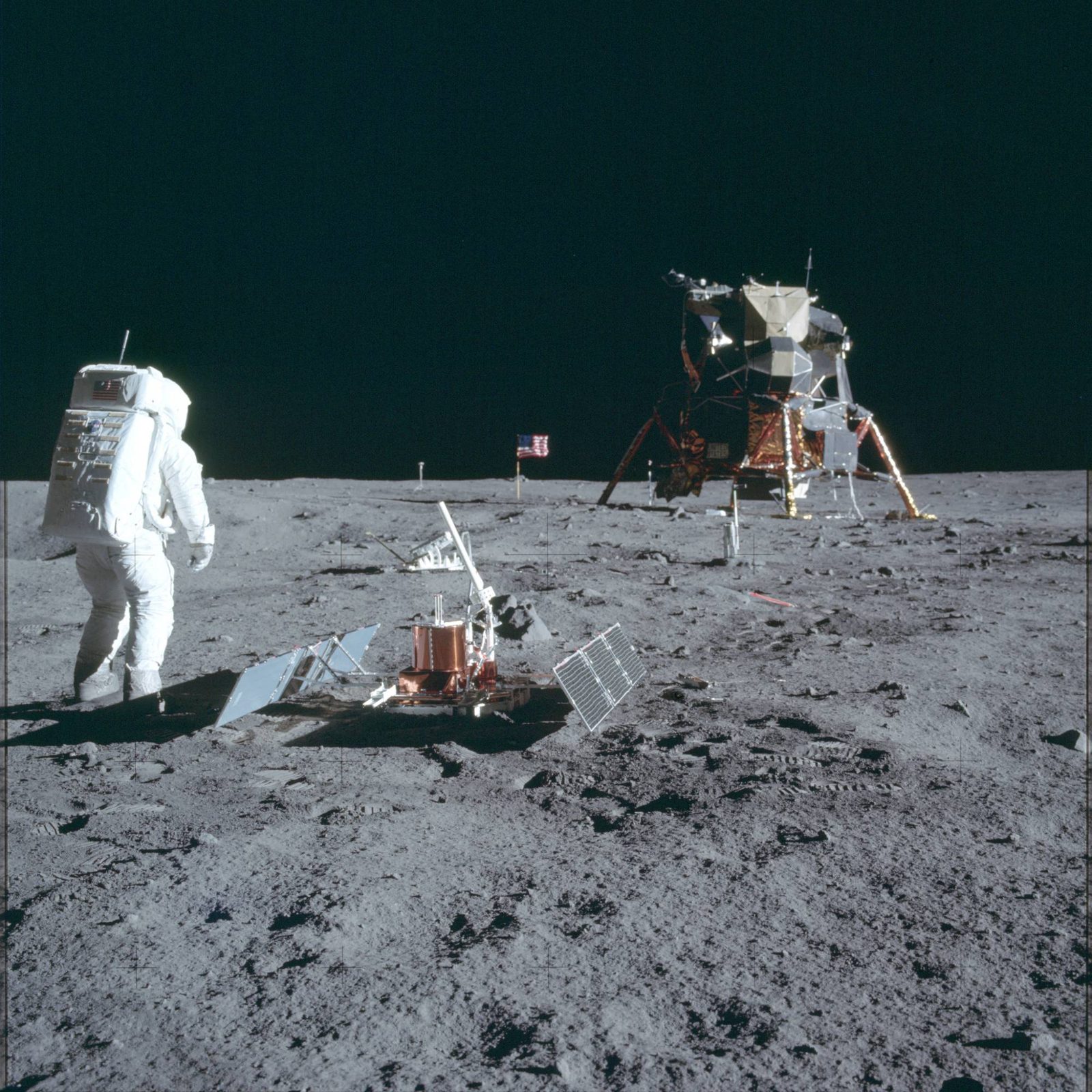
The Passive Seismic Experiment (experiment number S‑031, “Lunar Passive Seismology”) was one of the two EASEP experiments deployed during the Apollo 11 EVA. The Passive Seismic Experiment Package was a solar-powered seismometer station (about 48 kg) designed to detect lunar seismic events — moonquakes and meteoroid impacts — and so to probe the structure of the lunar interior, the first such station emplaced on another world. The package also carried a Modified Dust Detector, a small engineering experiment measuring dust accumulation and radiation degradation of its solar cells.
The principal investigator was Gary Latham of the Lamont Geological Observatory. Per the EASEP Handbook, each PSE combines three long-period (LP) seismometers (sensing tri-axial ground motion at periods of roughly 250–0.3 s with a LaCoste-spring suspension) and one short-period (SP) vertical seismometer (~5–0.04 s), with the sensor assembly under a “flat-crowned hat” thermal shroud and the electronics in the EASEP central station. The astronaut coarse-levels it within ±5° with a ball level; an automatic gimbal then fine-levels it. The handbook estimated about one detectable meteoroid impact per day (within 10–20 km) under optimistic assumptions, or as few as one per month at worst. The package’s dust detector is three solar cells whose voltage drop tracks dust and radiation degradation.
The Preliminary Science Report documents the experiment’s design and its initial data. Because the instrument relayed its measurements to Earth stations, its useful operating life on the short Apollo 11 mission was limited, but it established the technique that later ALSEP seismic networks extended across multiple landing sites.
Aldrin’s account in the crew debriefing (§10.40) flags a leveling problem: the ball-bearing bubble level (“the BB”) refused to settle into the center of its cup, instead riding the perimeter at “about 11 o’clock” no matter how he tilted the package, as if the cup “had somehow changed its shape and was convex.” He leveled it visually and moved on — and when Armstrong came by with the camera moments later, the BB had settled dead center on its own, with no explanation. Deploying the two solar panels produced “a certain amount of rocking… and dancing” that let two corners touch the surface and pick up a small patch of dust.
Per the Mission Report (§11.4) the seismometer ran through the first lunar day — returning data from late on July 20 until it was commanded off at lunar sunset on August 3 — despite operating temperatures up to 50 °F above the planned maximum.
The instrument’s first signals were an unplanned calibration: after the EVA, when the crew threw their PLSS backpacks out the hatch, the already-live seismometer registered each impact — Houston relayed, “the passive seismic experiment recorded shocks when each PLSS hit the surface” (~114:18 GET, air-to-ground transcript; see the EVA master timeline) — two impacts of known location and roughly known mass, a free check of the station’s sensitivity before any natural event arrived.
The PSE team’s later network report (Latham et al. 1977) states the station’s end plainly: solar-powered and “intended for operation only during the lunar day,” it failed after exposure to the first nighttime period — the RTG-powered stations of Apollo 12/14/15/16 carried the listening on. What that network found — the quantified quiet Moon, the moonquake classes, the molten-core evidence — is told in lunar seismicity and interior structure.
Related
- Lunar seismicity and interior structure (PSE results)
- Early Apollo Scientific Experiments Package (EASEP)
- Laser Ranging Retroreflector (S‑078)
- Solar Wind Composition experiment (S‑080)
- Apollo 11 EVA (first moonwalk)
- LROC imaging of the Apollo 11 landing site
Sources
- EASEP Handbook for Apollo 11 Flight Crew
- Apollo 11 Preliminary Science Report
- Apollo 11 Lunar Surface Operations Plan
- Apollo 11 Technical Crew Debriefing — Volume 1
- Apollo 11 Mission Report (MSC-00171)
- LROC NAC imagery of the Apollo 11 landing site
- Results from the Apollo Passive Seismic Experiment (Latham et al., 1977)