
The simplest way to compare Homeric Greek with English is to keep both texts visible at once and move through the poem in parallel. Breaker of Horses does this with synchronized reading panes: the Greek of the Iliad or Odyssey on one side, and Samuel Butler, Alexander Pope, or George Chapman on the other.
The Greek text in Breaker of Horses comes from the Perseus Digital Library. For the Iliad, the app identifies the Greek as the Monro–Allen edition; for the Odyssey, the A. T. Murray text. Polytonic Greek, verse divisions, and line numbering are preserved rather than flattened into prose.
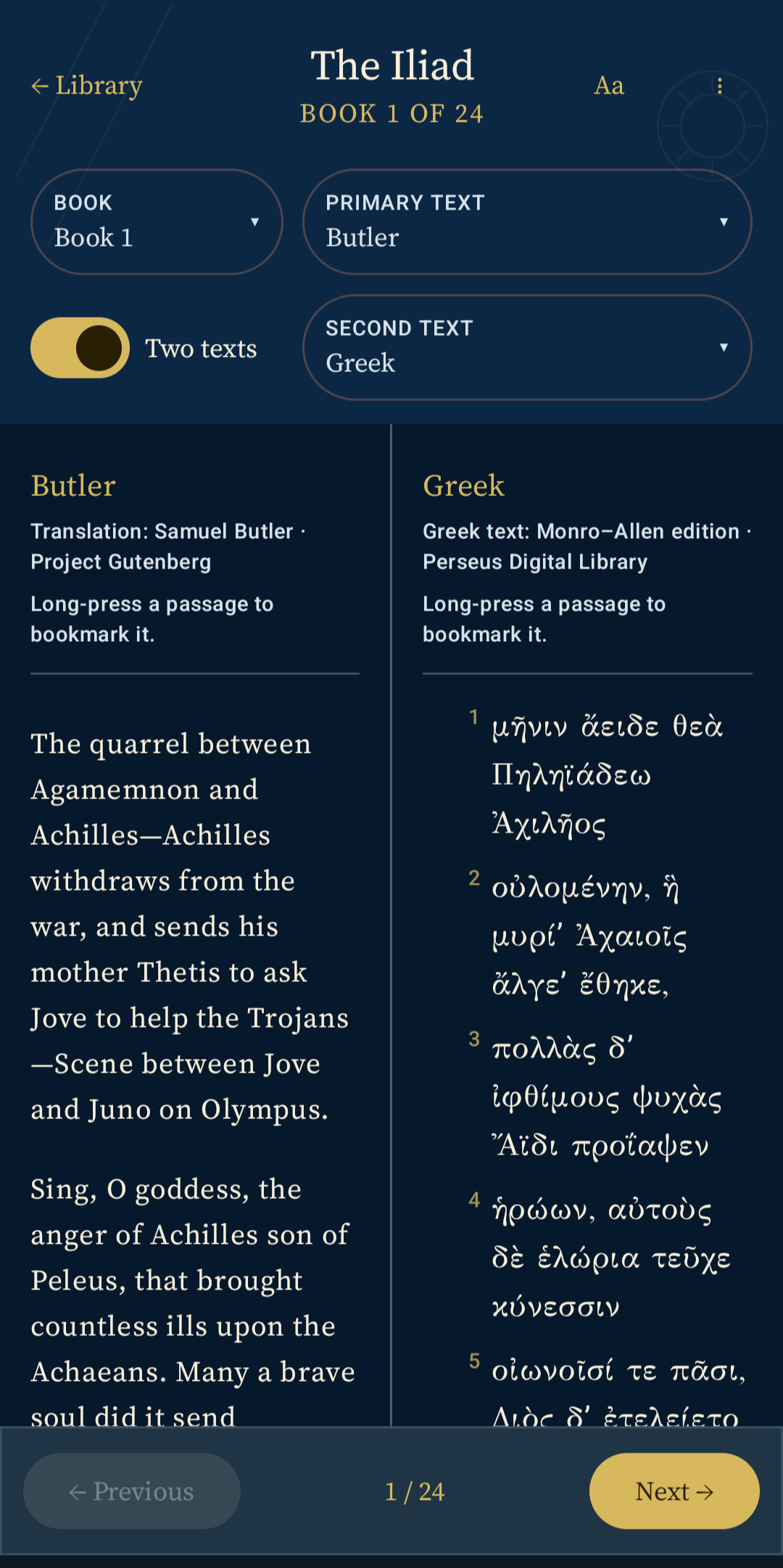
The Greek does not have to be fully readable to be worth seeing
For a beginning Greek student, an English translation can provide orientation while the eye learns to recognize names, repeated words, particles, endings, and the physical shape of Homeric verse. The English should not become a line-by-line crib. It is better used as a map: enough information to know where the passage is going while attention remains on the Greek.
Even an English-only reader gains something. Greek lineation makes the materiality of the original visible. Names repeat in forms that English smooths away. A compact Greek phrase may expand dramatically in translation. A translator may supply connective tissue, heighten an image, or compress a repeated formula.
The presence of the source text makes those decisions harder to forget.
Three English versions produce three different comparisons
Breaker of Horses includes three deliberately old and very different public-domain English Homers. None is a neutral window.
Greek + Samuel Butler
Butler's late-Victorian prose is the most straightforward companion when the chief purpose is orientation. It sacrifices meter for narrative clarity and tends to let the sequence of events remain easy to follow. For a reader trying to keep attention on the Greek, that relative plainness can be useful.
Greek + Alexander Pope
Pope is almost the opposite experiment. His Homer is an eighteenth-century English poem of heroic couplets, polished, musical, and often more ornamented than the Greek. Reading Pope beside Homer makes translation visibly historical. One is not merely watching Greek words become English words; one is watching Augustan England decide what Homer ought to sound like.
Greek + George Chapman
Chapman gives another transformation: vigorous early-modern English, expansive and rhetorically charged. His Iliad moves in long rhymed fourteeners. The pleasure of the comparison is partly excess. The distance between Chapman's energy and the visual economy of the Greek can be as revealing as a close verbal correspondence.
Use the panes for questions, not just confirmation
Parallel reading becomes much more interesting when the English is treated as evidence rather than an answer key.
Pause occasionally and ask:
- Why is the English noticeably longer than the Greek here?
- Does a repeated Greek word become several different English words?
- What happens to a formula that appears again later?
- Does the translator make a character sound more dignified, violent, sentimental, or modern?
- What has happened to the rhythm?
- Does another English translation make the same decision?
These questions remain useful even when the Greek competence required to answer them fully is still being acquired.
Parallel text is not a critical edition
A synchronized reader is convenient precisely because it removes apparatus. That is also its limitation.
Serious philological work may require a critical text, textual notes, lexicon, morphology tools, commentary, manuscript information, and scholarly discussion. Breaker of Horses does not replace those things. Perseus itself and specialist editions provide deeper tools when the question demands them.
What a parallel reader does unusually well is lower the friction of looking at the Greek at all. Instead of opening one site for the source, another book for a translation, and repeatedly hunting for the corresponding place, both remain in the reading field.
The source text changes the status of the translation
An English Homer can easily become “Homer” in the reader's imagination. This is unavoidable to some degree. Most readers encounter ancient literature through translation, and great translations deserve to be read as literature themselves.
But placing the Greek beside the English restores a useful uneasiness. Pope is Pope. Chapman is Chapman. Butler is Butler. Homer is still sitting next to them, visibly not identical to any of the three.
That is a modest but important form of classical literacy.
A relevant Ulix tool
Breaker of Horses
Breaker of Horses is a free Android reader for the complete Iliad and Odyssey. It includes Perseus-sourced Homeric Greek and public-domain English translations by Samuel Butler, Alexander Pope, and George Chapman, with synchronized single- or dual-pane reading.